

“Every major enterprise software vendor now claims an agentic AI platform, yet most products are rebranded chatbot builders or workflow automators with an AI label. The distinction matters: genuine agentic platforms reason through multi-step problems, retrieve real-time data, take actions across business systems, and adapt when conditions change — capabilities that traditional automation, including most tools marketed as AI agents, fundamentally cannot deliver.
Gartner estimates only 130 of thousands of vendors offer genuine autonomous capability. This guide defines what makes a platform truly agentic, identifies the architectural requirements that separate agentic from non-agentic, and provides a practical framework for evaluating whether a vendor’s agentic claims hold up under production conditions.”
What Makes an AI Platform Truly Agentic? The 4 Autonomy Requirements
An enterprise agentic AI platform is an integrated software environment that enables organizations to build, deploy, orchestrate, and manage AI agents at scale. Unlike standalone LLM APIs or lightweight chatbot builders, these platforms provide the full operational infrastructure that enterprise deployments require: multi-agent coordination, deep system integrations, policy enforcement, observability, and complete agent lifecycle management.
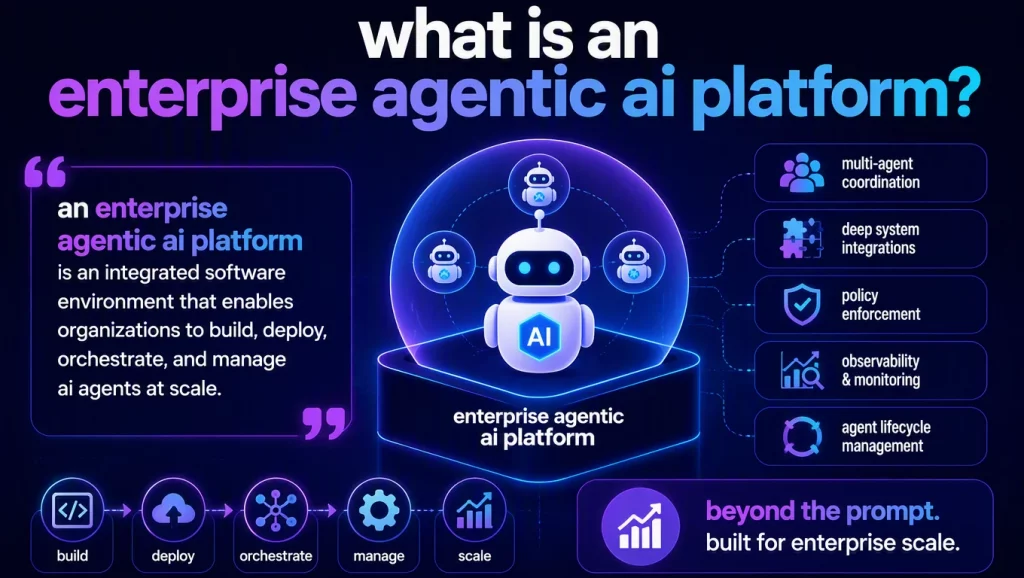
The distinction between an agentic AI platform and a basic AI tool is analogous to the difference between a web application framework and a static HTML page. Both produce output, but only one supports the authentication, database integration, error handling, monitoring, and deployment pipeline that production applications demand. Similarly, an enterprise agentic AI platform handles the 90% of work that happens beyond the initial prompt-response interaction.
Agentic AI vs. Traditional Automation: Why the Shift Is Happening Now
Enterprises spent the last decade automating repetitive tasks with RPA, workflow tools, and rule-based systems. Those tools delivered real value — until the work became more complex, less predictable, and required judgment.
That is why the shift to agentic AI is accelerating in 2026. Traditional automation follows instructions. Agentic systems pursue goals. The difference is not incremental. It changes what can be automated, how teams operate, and where competitive advantage comes from.
This article breaks down the architectural gap, gives you a practical way to test vendors, and explains why most “agentic” platforms still fail when enterprises try to scale them.
Core Capabilities of a Production-Ready Enterprise Agentic AI Platform
Not every platform that markets itself as enterprise-ready delivers the capabilities that production deployments require. These are the non-negotiable features that separate viable platforms from those that will leave your team stranded.
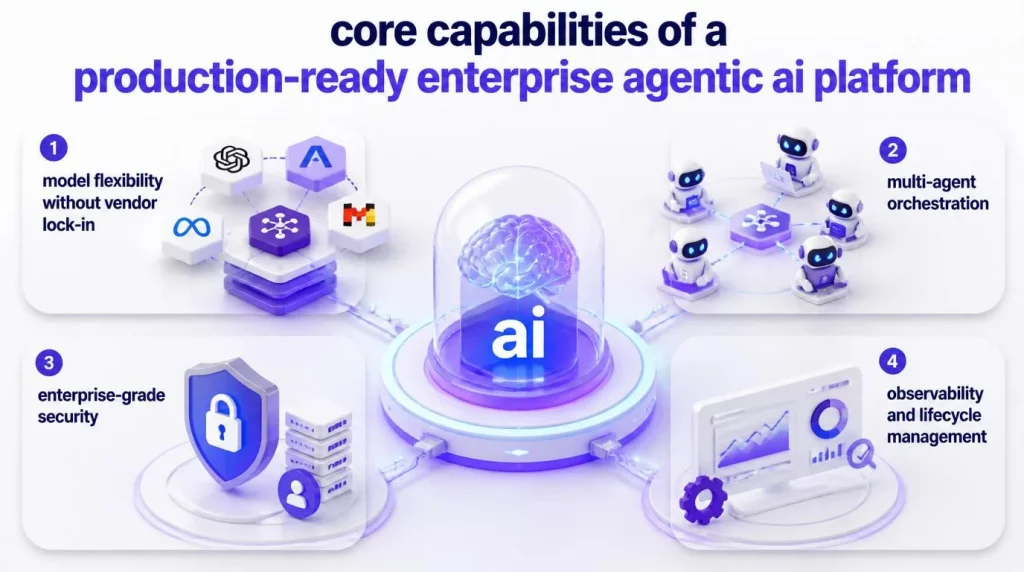
1. Model Flexibility Without Vendor Lock-In
Your enterprise should not be locked into a single LLM provider. Production requirements change: a model that excels at reasoning may not be cost-effective for high-volume classification tasks. A genuine enterprise agentic AI platform supports multiple model providers, including Claude, GPT-4, Gemini, and open-source models like Llama, and allows routing between them based on task requirements and cost constraints. Our platform at AI Hive supports model-agnostic deployment across all major providers, which enables enterprises to optimize cost and performance simultaneously.
2. Multi-Agent Orchestration
Production workflows rarely involve a single agent working in isolation. A customer onboarding process might require a document extraction agent, a compliance verification agent, a CRM update agent, and a notification agent working in coordinated sequence. The platform must support defining dependencies between agents, passing context and results between workflow stages, handling failures and retries at each step, and monitoring the overall workflow status. Enterprise AI agent solutions that lack multi-agent orchestration force teams to build coordination logic in application code, which becomes a maintenance liability.
3. Enterprise-Grade Security
Security and governance kill more deals than missing features. Production platforms must deliver tenant isolation for multi-customer deployments, role-based access control for agent management and data access, comprehensive audit logging of all agent actions and decisions, PII detection and masking to prevent sensitive data exposure, and encryption at rest and in transit with customer-managed keys where required. IBM’s 2026 AI security benchmark reported that 47% of enterprise AI deployments experienced a data exposure incident during their first year, with the majority traced to inadequate access controls in the agent layer.
4. Observability and Lifecycle Management
Deploying an agent is the beginning, not the end. Production platforms provide real-time dashboards showing agent performance, accuracy, and cost metrics along with alerting for accuracy degradation, latency spikes, or unusual tool usage patterns. Version management enables teams to roll back to previous agent configurations when issues arise, while A/B testing capabilities allow comparison of agent versions in production before full rollout.
What to Look For in an Enterprise Agentic AI Platform: An Evaluation Checklist for Enterprise Buyers
When your organization evaluates an enterprise agentic AI platform, these criteria separate solutions that will reach production from those that will remain in pilot.
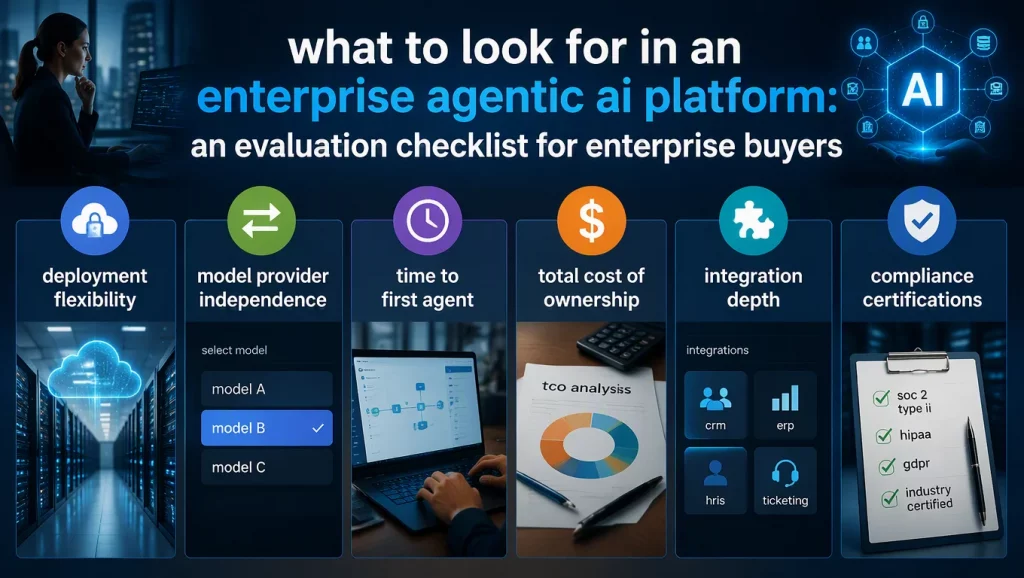
- Deployment flexibility: Can the platform deploy on your private cloud or on-premise infrastructure? Data sovereignty requirements in healthcare, finance, and government often prohibit cloud-only solutions.
- Model provider independence: Does the platform support switching between LLM providers without rewriting agent logic? Vendor lock-in to a single model provider creates risk if pricing or performance changes.
- Time to first agent: How long from contract signing to a production agent? Platforms with pre-built templates and marketplace agents can deliver in 2 to 4 weeks. Custom-only platforms may take 3 to 6 months.
- Total cost of ownership: Look beyond licensing fees. Include implementation services, training, ongoing support, and the compute costs for model inference. Ask for a TCO projection based on your expected usage volume.
- Integration depth: How does the platform connect to your existing CRM, ERP, HRIS, and ticketing systems? Native connectors reduce implementation time. API-only integration shifts the burden to your engineering team.
- Compliance certifications: SOC 2 Type II, HIPAA, GDPR, and industry-specific certifications should be current, not on the roadmap. Ask for audit reports, not marketing claims.
The Agentic Architecture Stack: What Non-Agentic Platforms Are Missing
Most platforms that market themselves as “AI agents” are still traditional automation with a language model bolted on. They can answer questions or trigger fixed workflows. They cannot independently plan, adapt, or recover from failure.
A true agentic architecture requires five core layers that most non-agentic platforms lack:
| Layer | What It Does | Traditional Automation | True Agentic Platform |
|---|---|---|---|
| Perception | Understands context and current state | Limited to predefined triggers | Continuously interprets environment and data |
| Planning | Breaks goals into multi-step plans | Fixed sequences only | Dynamic planning and re-planning |
| Tool Use | Selects and chains tools/APIs | Hard-coded actions | Decides which tools to use and in what order |
| Memory | Retains context across steps and sessions | Stateless or short-lived | Long-term and working memory |
| Reflection | Evaluates outcomes and self-corrects | No self-correction | Detects failure and retries with improved approach |
Without these layers working together, a system remains reactive. It waits for instructions. An agentic system receives a goal (“resolve this customer issue end-to-end”) and works toward it with minimal human intervention.
This architectural difference explains why many enterprise pilots look impressive in demos but collapse in production. The underlying stack was never designed for autonomy.
How to Test if a Vendor Is Truly Agentic: 5 Proof Points
Marketing language is cheap. Here are five concrete tests you can run during a vendor evaluation or proof-of-concept.
- Multi-step goal execution without step-by-step prompting: Give the system a high-level objective instead of a sequence of commands. A true agent should plan the steps, execute them, and only escalate when necessary. If the system requires you to prompt every action, it is still a chatbot with tools.
- Dynamic tool selection and chaining: Ask the agent to complete a task that requires multiple systems (CRM + email + knowledge base + ticketing). Observe whether it decides which tools to call and in what order, or whether it only follows a pre-built path.
- Persistent memory across sessions: Start a task, pause it, and return later. A genuine agentic platform retains context, previous decisions, and partial progress. Stateless systems force users to re-explain everything.
- Multi-agent coordination: Request a workflow that needs specialization (research agent + analysis agent + execution agent). True platforms can assign roles, hand off work, and manage dependencies. Single-agent systems struggle here.
- Self-correction and recovery: Intentionally introduce a failure (wrong data, unavailable API, conflicting information). Watch whether the system detects the problem, adjusts its plan, and continues — or simply stops and waits for a human.
Vendors that fail two or more of these tests are not delivering agentic capability. They are delivering assisted automation.
The Enterprise Readiness Gap: Why Most Agentic Platforms Fail at Scale
Even platforms that pass the five proof points often break when enterprises move from pilot to production. The gap is rarely the model. It is everything around the model.
Common failure points include:
- Missing governance and audit trails – Enterprises need to know why an agent took an action, who approved it, and what data it accessed.
- Weak human-in-the-loop controls – Full autonomy sounds attractive until an agent makes a high-stakes decision without oversight.
- Uncontrolled costs – Autonomous agents can generate large volumes of tokens and API calls. Without guardrails, monthly bills become unpredictable.
- Poor observability – Teams cannot debug or improve what they cannot see. Production agents require tracing, evaluation metrics, and performance dashboards.
- Limited deployment options – Many platforms are cloud-only. Regulated industries often require on-premise or private-cloud control over data and models.
These gaps explain why analyst reports in 2026 continue to show a large drop-off between successful pilots and scaled deployments. The technology works in controlled environments. It fails when security, compliance, cost, and reliability requirements appear.
Enterprises that succeed treat agentic AI as a platform decision, not a model decision. They prioritize systems that combine reasoning capability with enterprise-grade controls from day one.
The AI Hive Approach: Bridging the Gap Between Pilot and Production
We built AI Hive specifically to solve the pilot-to-production gap that stalls 80% of enterprise AI projects. Our enterprise agentic AI platform combines four pillars that address the most common failure points.
The SaaS platform provides a self-service environment for building and managing agents with pre-configured compliance controls. Modular implementation supports deployment on private cloud or on-premise infrastructure for organizations with strict data sovereignty requirements. The agent marketplace offers over 500 pre-built agent templates organized by industry and use case, reducing time to first production agent from months to weeks. For organizations that lack in-house AI engineering talent, our AI engineers for hire service provides dedicated specialists who build and deploy custom agents on your behalf.
Conclusion
The enterprise agentic AI platform market in 2026 offers more options than ever, but the fundamental selection criteria remain unchanged: model flexibility, deployment options, compliance readiness, and the ability to move agents from prototype to production without a six-month implementation timeline. The organizations that succeed with enterprise AI are those that choose platforms built for production operations from day one, not those that try to scale a prototype framework into an enterprise-grade system after the fact.
Your enterprise deserves a platform that treats the pilot-to-production gap as a solved problem rather than a future roadmap item. Reach out to the AI Hive team to see how our platform, marketplace, and engineering support can get your first agent into production within weeks.