

The “AI-powered” label is everywhere right now, and it means almost nothing. Companies attach it to products, pitches, and press releases without asking the harder question: does this actually solve a problem someone is paying to have solved? The answer, for most AI-powered projects in 2025, was no. MIT’s 2025 GenAI Divide Report found that 95% of generative AI pilots delivered zero measurable financial return, and S&P Global Market Intelligence reported that 42% of companies abandoned most of their AI initiatives that same year, up from just 17% the year before. The failure rate isn’t stabilizing. It’s getting worse. Here’s what’s actually behind AI illusion, and what the minority of successful deployments do that most teams skip.
Key Takeaways
|
Mistake 1: Automating the Wrong Thing
Most teams enter their first AI project convinced the problem is execution speed. It usually isn’t. The harder and more expensive error is building a highly capable AI system pointed at the wrong target entirely.
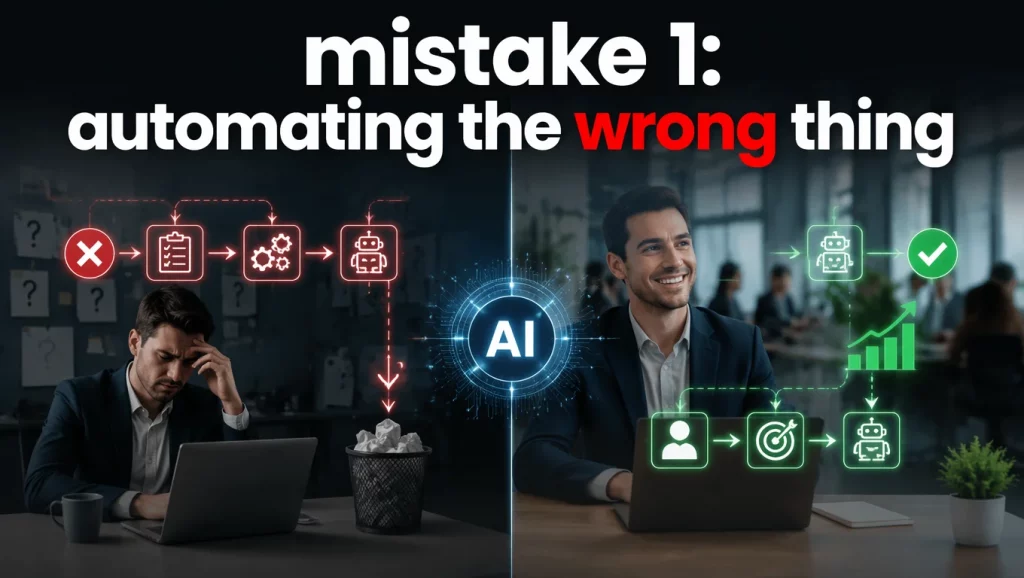
Companies regularly spend six figures building AI systems to accelerate internal workflows, improve data processing speed, or automate reporting – and then discover the real problem was somewhere else entirely. The product nobody wanted to buy. The market that didn’t exist at the right price point. The customer pain point that was never validated before a single line of code was written. McKinsey’s 2025 AI survey found that organizations reporting significant financial returns from AI were twice as likely to have redesigned end-to-end workflows before selecting a model or vendor. In other words, the technology came second. The workflow clarity came first.
AI doesn’t create demand. It amplifies whatever is already working, or whatever is already broken. Pouring automation into a leaky business doesn’t fix the leak – it moves water faster toward the drain. Consequently, the question worth asking before any AI decision gets made is blunt: are we solving a real pain point for the end user, or are we making an internal process marginally more efficient while the actual problem stays untouched?
Customers don’t buy technology. They buy solutions to their own headaches. If your AI-powered project doesn’t map directly to a problem your customers are actively paying to solve, it’s expensive wallpaper.
Mistake 2: Building the Tower Before the Foundation
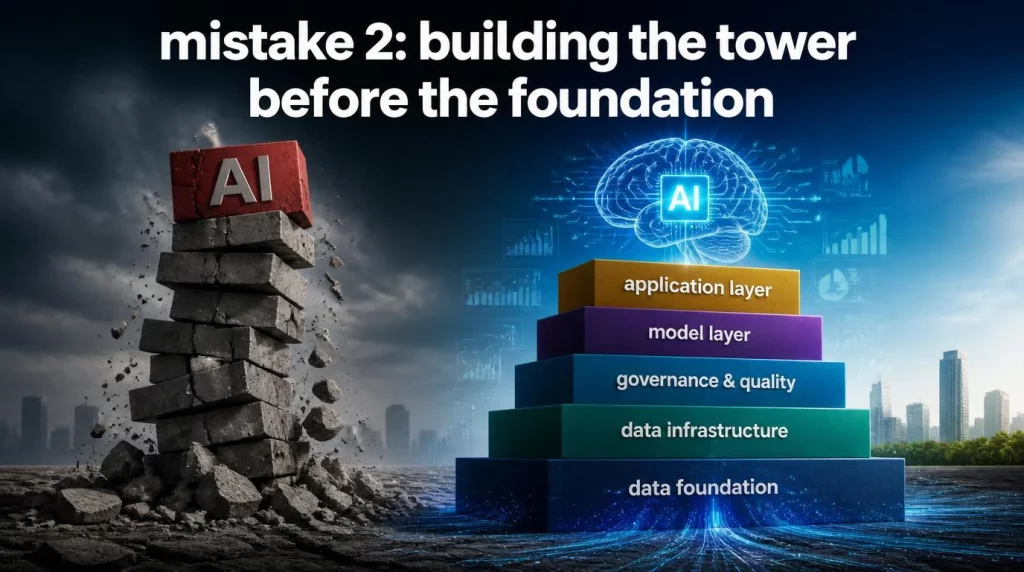
The gap between a prototype that works in a demo and a system that holds weight at production scale is almost entirely infrastructure. This is the part that’s not glamorous enough to make it into the pitch deck, but it’s where most enterprise AI deployments quietly collapse.
RAND Corporation’s 2024 study of enterprise AI deployments found that the most fundamental failure mode happens before any model is selected or any training data is assembled. Business leaders describe desired outcomes in language that technical teams interpret differently. Technical teams then propose solutions to problems that don’t quite match what the business actually needs. By the time the mismatch surfaces, six months and significant budget have gone into architecture that solves the wrong version of the problem.
What most teams skip – because it’s slow and unglamorous – is building system architecture that can scale without collapsing under its own weight. This means data infrastructure that stays clean at volume, integration layers that don’t break every time an upstream system updates, and governance and monitoring built in from the start, not bolted on after the first production incident. Informatica’s 2025 CDO Insights survey found that 43% of organizations cited data quality and readiness as their top obstacle to AI success, and that winning programs earmarked 50-70% of their timeline and budget for data readiness before writing a single line of model code.
Shortcuts in foundation show up later as exponential maintenance costs, scaling failures, and technical debt that makes the whole system cheaper to rebuild than to fix. The better question isn’t “how fast can we ship?” It’s “how much of this will we have to throw away in 18 months?”
Mistake 3: The Leaky Bucket Problem
Pouring budget into acquiring new customers while existing ones quietly churn is a structural growth problem. AI makes it more visible, not less – and most AI roadmaps are organized in a way that makes it worse.
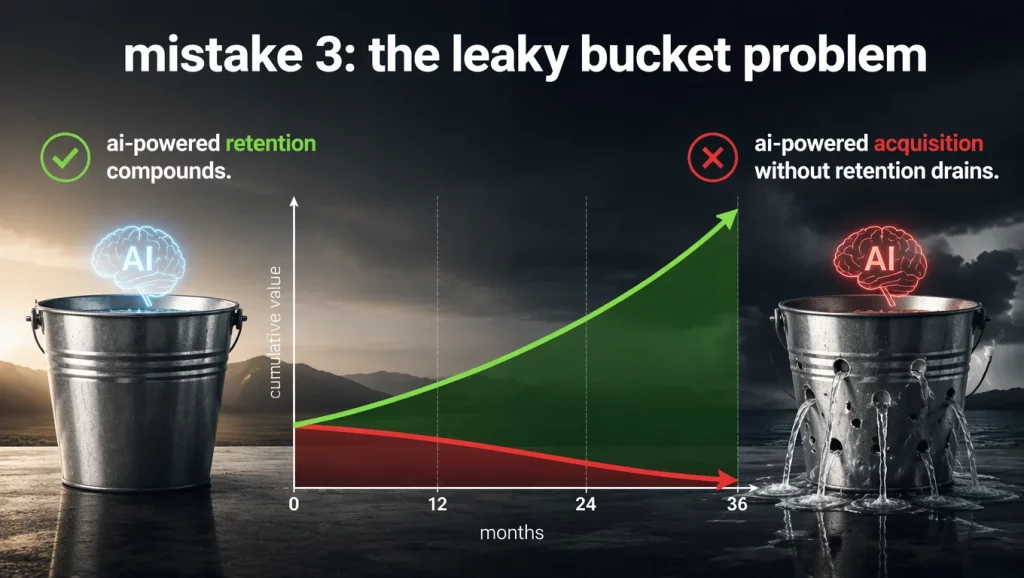
The math behind this is straightforward. A product that retains 100 customers compounds over time in a way that acquiring 200 new ones every quarter can’t match, especially once you factor in what those 200 cost to acquire. Most AI product roadmaps are weighted toward acquisition features – new channels, new conversion flows, new reach – while the reasons existing customers leave get deferred to the next sprint indefinitely. This happens because AI tools make acquisition easier to measure and optimize. Teams naturally chase the metric they can see. Retention, by contrast, is harder to instrument, slower to show results, and less exciting to present in a board deck.
The deeper issue is that AI deployed in service of acquisition is trying to fill a bucket that may still have a hole in it. A product that genuinely retains customers does so because it solves a real problem better over time. That’s a product strategy question, not an AI strategy question. Specifically, AI deployed in service of that retention goal – improving what users experience every time they return – is the version that compounds. The version that only chases new users eventually runs out of budget before it runs out of churn.
Mistake 4: Waiting for the Unicorn Hire
At some point, almost every founder starts imagining the one hire who’ll replace them at everything: sharp on strategy, relentless on execution, reliable when systems break at 2 AM. That person doesn’t exist. Waiting for them is just stalling with better vocabulary.
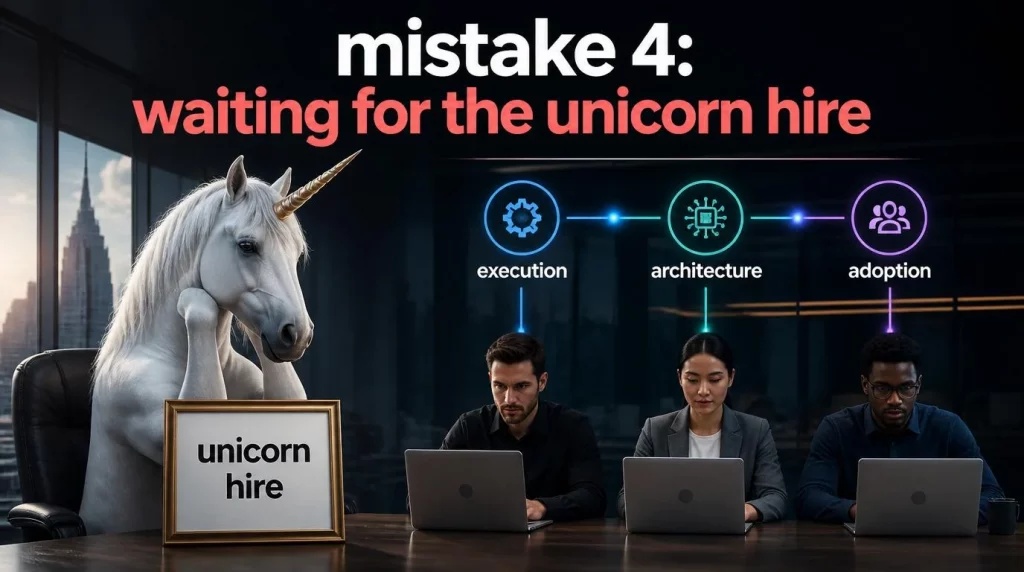
This particular mistake matters in AI specifically because successful deployments require a broader coalition than most teams expect going in. Data quality is an operational problem. Model selection and architecture are technical problems. Change management – getting actual users to use the system and trust its outputs – is a people problem. S&P Global’s 2025 data confirms the pattern: organizations that cited skill shortages as a top obstacle were disproportionately the ones that had tried to consolidate all three domains into one or two roles. The gap wasn’t that they couldn’t find a brilliant individual. The gap was that no brilliant individual covers all three domains well, because the skills don’t travel together.
The more durable approach is to break the requirement down honestly. One person who pushes hard on execution and gets things shipped. One who thinks clearly about architecture and data quality. One who owns the human side of adoption, because a system nobody trusts doesn’t get used regardless of how accurate the model is. As a result, a team that patches each other’s blind spots outlasts any generalist – every time, at every scale.
The Pattern Behind the Failure Rate
The four mistakes above aren’t separate problems. They’re symptoms of the same underlying one: treating AI as a solution in search of a problem, rather than as a tool applied to a problem that’s already been confirmed real and worth solving.
Gartner’s current forecast projects that over 40% of agentic AI projects will be cancelled before the end of 2027, citing escalating costs, unclear business value, and inadequate risk controls. That number will climb if the underlying behavior doesn’t change. The companies that come through the current period of disillusionment – which Gartner maps as the Trough of Disillusionment in its AI Hype Cycle – will be those that validated the problem before building the solution. For a deeper look at what that infrastructure layer looks like in practice, the guide on AI agent use cases by industry covers how organizations move from single-use AI tools to coordinated agent deployments.
AI is a genuinely powerful tool. The companies that use it well aren’t the ones who adopted it earliest. They’re the ones who were honest about what problem they were solving before they started. The AI badge doesn’t make a weak business strong. It makes the strengths stronger and the weaknesses harder to hide.
Conclusion
Most AI-powered projects fail not because the technology is wrong, but because the fundamentals were skipped. Wrong problem. Wrong foundation. Wrong team structure. A growth model built on acquisition instead of retention. The MIT, RAND, and S&P Global data all converge on the same conclusion: the gap between what organizations spend on AI and what they get back is a strategic clarity problem, not a technology one. Fixing AI illusion means treating it as a force multiplier for a business that was already solid, not as a shortcut past the hard work of building one.
If your team is ready to move from AI experimentation to production-grade deployment, AI Hive’s enterprise AI agent platform helps organizations build the infrastructure, governance, and agent architecture to make that transition in weeks rather than months. The goal isn’t more AI. It’s AI that actually reaches production.