

Until June 30, 2026, enterprises that wanted Claude’s strongest agentic performance had one real option: pay Opus 4.8 pricing. Anthropic’s launch of Claude Sonnet 5 changed that equation overnight, closing much of the performance gap at roughly 60% lower cost. However, the tokenizer behind that lower price also quietly eats into the savings, and Sonnet 5 still falls short of Opus 4.8 on several benchmarks that matter for regulated industries. Follow this article to see exactly where Claude Sonnet 5 wins, where it still loses to Opus 4.8, and how to price out the real cost before you migrate a single production agent.
Key Takeaways
|
What Is Claude Sonnet 5?
Claude Sonnet 5 is the sixth generation of Anthropic’s mid-tier Sonnet model, positioned between the faster, cheaper Haiku line and the flagship Opus line. According to Anthropic’s official Claude Sonnet 5 announcement, the model is described as its most agentic Sonnet model to date, built to plan multi-step tasks, operate tools such as browsers and terminals, and continue working without a human checking in after every step. The model became the default for Free and Pro users on claude.ai on launch day, and it is also available on Max, Team, and Enterprise plans, inside Claude Code, and through the Claude API under the model string claude-sonnet-5.

The timing matters here. Anthropic’s top-tier Mythos-class models, Claude Fable 5 and Claude Mythos 5 were suspended under a US export-control order that took effect June 12, 2026. Access was restored on July 1, 2026, one day after Sonnet 5 shipped. During that window, Sonnet 5 was effectively the strongest generally available Claude model outside of Opus 4.8, a detail worth knowing if your enterprise is deciding which model to standardize on for agent workflows.
Claude Sonnet 5 Benchmarks: Verified Numbers vs Sonnet 4.6 and Opus 4.8
Sonnet 5 improves over Sonnet 4.6 on every benchmark Anthropic has published, and it closes most of the gap to Opus 4.8 without consistently surpassing it. However, Anthropic’s launch post presents its full benchmark comparison as a chart image rather than a text table, which limits how precisely we can cite it.
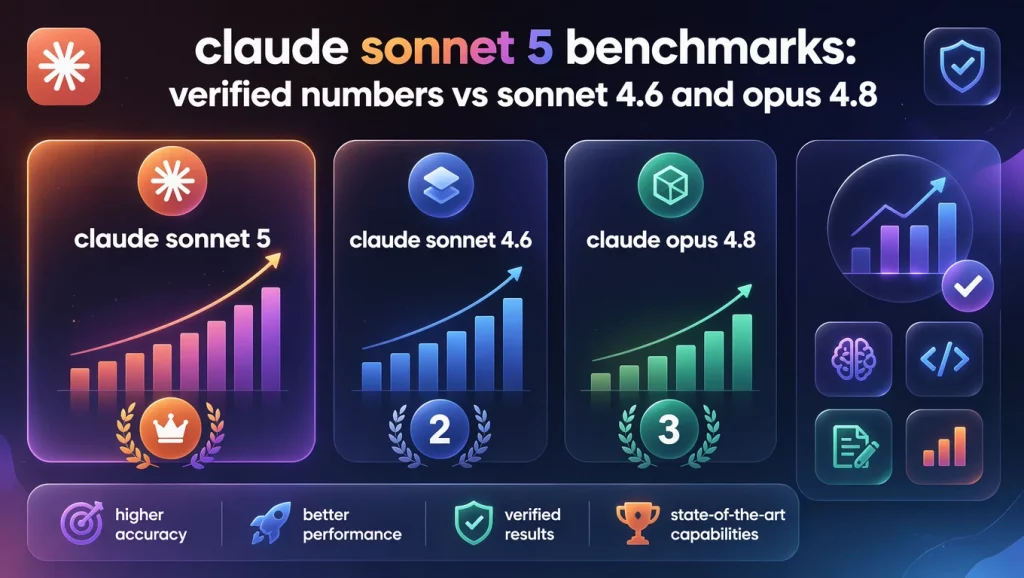
Two figures below come directly from Anthropic’s own published text: Sonnet 4.6 scored 78.5% on OSWorld-Verified and 34.6% (no tools) / 46.8% (with tools) on Humanity’s Last Exam, both restated under Anthropic’s updated grading methodology at the Sonnet 5 launch. The remaining Sonnet 5 and Opus 4.8 figures are as reported consistently across multiple independent outlets that reviewed the Sonnet 5 System Card. We have not independently re-derived them from the source chart image, so treat them as reported rather than self-verified.
| Benchmark | Sonnet 4.6 | Sonnet 5 | Opus 4.8 |
| SWE-bench Pro (agentic coding) | 58.1%* | 63.2%* | 69.2%* |
| OSWorld-Verified (computer use) | 78.5% (Anthropic, confirmed) | 81.2%* | 83.4%* |
| Humanity’s Last Exam, with tools | 46.8% (Anthropic, confirmed) | 57.4%* | 57.9%* |
| GDPval-AA v2 (knowledge work, Elo) | 1,395* | 1,618* | 1,615* |
| Terminal-Bench 2.1 (shell/agentic tasks) | 67.0%* | 80.4%* | Not consistently reported |
Figures marked with an asterisk are as reported by independent recaps of Anthropic’s launch chart (DataCamp, BuildFastWithAI), not read directly from the source image by us. For a procurement or budget decision, pull the exact chart from anthropic.com/news/claude-sonnet-5 or the Sonnet 5 System Card before finalizing.
What stands out most is how close Sonnet 5 now sits to Opus 4.8. On most evaluations the gap has narrowed to 2 to 6 points, well inside the margin that would make a cost-conscious buyer pause before paying the Opus premium. On GDPval-AA v2, a knowledge-work benchmark, Sonnet 5 goes a step further and actually edges past Opus 4.8. As far as we can tell from Anthropic’s published record, that is the first time a Sonnet-class model has outscored its own flagship on a published evaluation, and it is worth watching whether that pattern holds once independent labs run their own tests.
Anthropic also introduced adjustable effort levels for Sonnet 5, ranging from low to an extra-high (“x-high”) setting. At its highest effort level, Sonnet 5 approaches Opus 4.8’s performance at a medium-to-high effort setting on select agentic benchmarks. Running Sonnet 5 at maximum effort, however, consumes more tokens, so the cost advantage over Opus 4.8 can shrink or disappear entirely on the hardest tasks.
Independent Benchmark: A More Cautious View
Artificial Analysis independent Sonnet 5 evaluation, an independent model evaluation firm, ran its own Intelligence Index test ahead of the public launch and placed Sonnet 5 fifth overall, behind Opus 4.7, Opus 4.8, and Claude Fable 5. If you are trying to understand how Anthropic’s top tier splits between those two flagship models, our Claude Fable 5 vs Claude Mythos 5 comparison breaks down the distinction in more depth. For now, the key point is simpler: Sonnet 5 is a clear step up from Sonnet 4.6, but it is not, by every independent measure, close to the top of Anthropic’s own model lineup, let alone the broader frontier field. Enterprises should treat “near-Opus performance” as true for specific agentic tasks, not as a blanket statement across every reasoning category.
Claude Sonnet 5 Pricing and Availability
Claude Sonnet 5 costs $2 per million input tokens and $10 per million output tokens at its introductory rate, available through August 31, 2026, before rising to $3 and $15. Anthropic priced it this way to be roughly cost-neutral against Sonnet 4.6 once the new tokenizer’s higher token count is factored in.
| Plan | Input (per million tokens) | Output (per million tokens) | Valid Through |
| Sonnet 5, introductory | $2 | $10 | August 31, 2026 |
| Sonnet 5, standard | $3 | $15 | From September 1, 2026 |
| Opus 4.8 | $5 | $25 | Ongoing |
Sonnet 5 is available today across the Free, Pro, Max, Team, and Enterprise tiers of claude.ai, inside Claude Code, and through the Claude API. It also ships with a 1 million token context window, large enough to load a full codebase or a lengthy compliance document in a single prompt. For agent builders comparing total cost of ownership, the token price alone does not tell the full story.
The Tokenizer Change: Why Your Bill May Not Drop As Much As Expected
The new tokenizer is the detail most procurement teams miss. Because the same document or codebase can now consume up to 35% more tokens than it did under Sonnet 4.6, a lower headline price does not automatically translate into a lower monthly bill. Specifically, English text expands roughly 1.33 to 1.42 times, code expands closer to 1.27 to 1.28 times, and Simplified Chinese remains largely unchanged.
We recommend auditing token consumption on a representative sample of your actual workload before migrating production agents from Sonnet 4.6 to Sonnet 5, rather than assuming the sticker price reflects real savings.
Key Features and Capabilities of Claude Sonnet 5
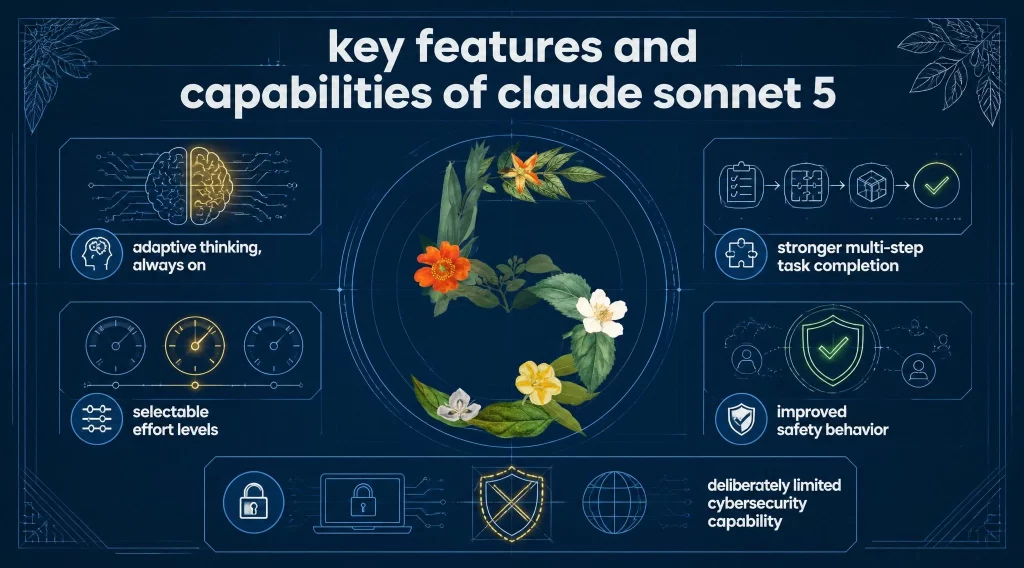
- Adaptive thinking, always on: Sonnet 5 scales its internal reasoning depth automatically based on task complexity, rather than requiring a manual toggle for every request.
- Selectable effort levels: Developers can choose low, medium, high, or x-high effort to balance speed, accuracy, and token cost per task.
- Stronger multi-step task completion: Anthropic and early access partners, including engineering teams at Cursor and Zapier, report that Sonnet 5 finishes end-to-end jobs that earlier Sonnet models would abandon partway through, such as updating CRM records and then sending a follow-up communication in a single pass.
- Improved safety behavior: Anthropic’s pre-deployment testing found lower rates of hallucination and sycophancy compared to Sonnet 4.6, along with stronger resistance to prompt injection attempts.
- Deliberately limited cybersecurity capability: Anthropic states it did not train Sonnet 5 specifically on offensive cybersecurity tasks, and the model scores considerably below Opus 4.8 in that category. Protective cyber controls are enabled by default.
Claude Sonnet 5 vs Opus 4.8: Which Should You Use?
| Factor | Choose Claude Sonnet 5 | Choose Claude Opus 4.8 |
| Cost sensitivity | High-volume agent workflows where token cost compounds | Lower-volume, high-stakes tasks where accuracy outweighs cost |
| Task type | Standard agentic coding, tool use, everyday professional work | Maximum-accuracy reasoning, complex multi-domain analysis |
| Security-sensitive tasks | Not recommended; weaker cyber-relevant performance by design | Preferred; higher capability and default protective controls |
| Effort tuning needed | Yes, to find the right cost-performance balance | Less critical, since baseline accuracy is already higher |
The honest conclusion from both Anthropic’s own data and independent testing is that Sonnet 5 makes Opus 4.8 optional for a meaningful share of enterprise agentic workloads, but it does not replace Opus 4.8 outright. Teams running tasks that touch sensitive systems, require maximum reasoning accuracy, or involve any security-adjacent function should still default to Opus 4.8 or a model with equivalent safeguards.
What This Means for Enterprise AI Agent Platforms
This is exactly the kind of decision AIHive’s model-agnostic architecture was built to simplify. Our platform supports Claude alongside OpenAI, Gemini, Llama, and Mistral models, plus bring-your-own-model options, so your organization is never locked into a single vendor’s release cycle or pricing strategy. We have watched enough model launches come and go to know that the temptation is always to move everything to whatever just shipped.
That instinct usually backfires. When a model like Claude Sonnet 5 launches with a genuinely better cost-performance ratio for certain tasks, our clients route specific agents to it immediately, while keeping higher-stakes workflows on Opus 4.8 or another model entirely, without rebuilding their agent infrastructure from scratch. You can review how this routing works in practice on our platform integrations page.
Furthermore, our engineering team maintains direct, verified proficiency with the Claude ecosystem specifically. AIHive engineers have completed Anthropic’s official API training program, which means model selection recommendations for your agents are grounded in hands-on platform expertise, not just published benchmark tables. For a mid-market bank or healthcare provider evaluating whether to route KYC document processing or clinical coding tasks through Sonnet 5 instead of Opus 4.8, that distinction carries direct compliance and cost implications.
Claude Sonnet 5 In Real Deployments: Where It Helps and Where It Falls Short
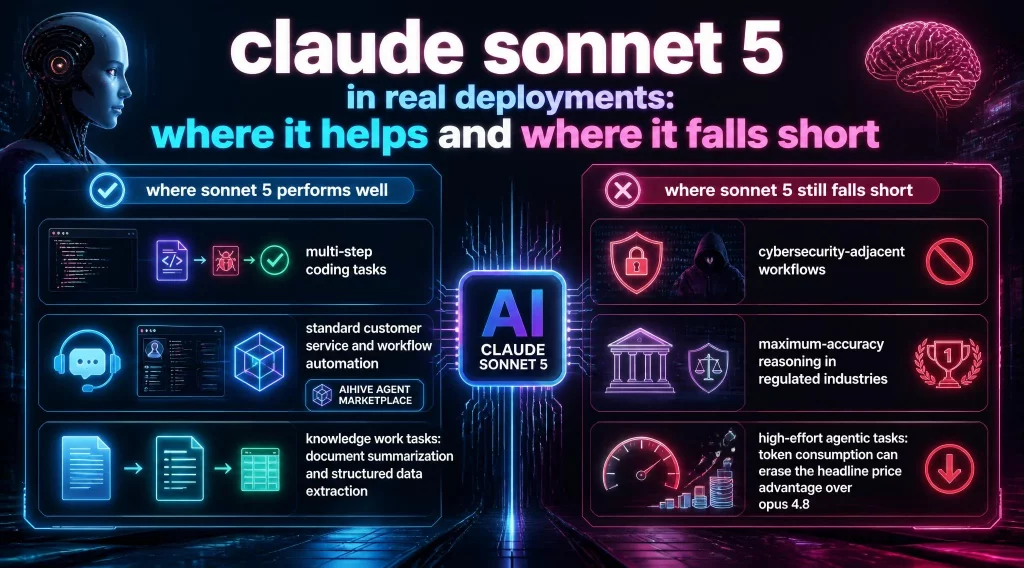
Where Sonnet 5 performs well:
- Multi-step coding tasks: writing a test, fixing a bug, and verifying the fix in one continuous pass.
- Standard customer service and workflow automation: cost per interaction matters at scale, and enterprises can start from a pre-built agent in the AIHive Agent Marketplace rather than building from scratch.
- Knowledge work tasks: document summarization and structured data extraction.
Where Sonnet 5 still falls short:
- Cybersecurity-adjacent workflows: Anthropic deliberately did not train the model on offensive security tasks.
- Maximum-accuracy reasoning in regulated industries: Opus 4.8 still leads on Anthropic’s own published benchmarks.
- High-effort agentic tasks: token consumption under the new tokenizer can erase the headline price advantage over Opus 4.8.
Conclusion
Claude Sonnet 5 gives enterprises a genuinely stronger, more cost-efficient option for agentic AI work. However, it is not a universal replacement for Opus 4.8, and the new tokenizer means the real price cut is smaller than the headline numbers suggest. Consequently, the right move is not to standardize on one model but to match each agent to the task, budget, and risk profile it actually faces.
This is precisely the model-selection problem AIHive’s model-agnostic AI agent platform was built to solve. Our engineers benchmark Claude Sonnet 5 alongside Opus 4.8 and every other supported model against your real workflows before a single agent reaches production. If your team is weighing a Sonnet 5 migration or planning a new AI agent workflow, talk to the AIHive team to find the right model and deployment path for your enterprise.