

Here’s a number worth sitting with: 80% of enterprise AI projects fail to deliver business value – twice the failure rate of conventional software. That’s not an outlier stat from a vendor’s whitepaper. RAND Corporation’s analysis of 2,400+ enterprise AI initiatives published this figure in 2025, and subsequent research from MIT, BCG, and S&P Global has only reinforced it.
Multi-agent orchestration is the architecture that determines which deployments make it across that gap, and which ones stall at the proof-of-concept stage. This article covers the core patterns, framework choices, real production failure modes, and the decision criteria every CTO and Innovation Manager needs before committing to a build.
Key Takeaways
|
What Is Multi-Agent Orchestration?
Multi-agent orchestration is a coordination layer that routes complex tasks across multiple specialized AI agents, enabling them to share context, collaborate on subtasks, and return a unified output – without each agent needing to handle the entire workflow alone.
Think about what happens when you try to build one AI agent that handles KYC verification, AML screening, and CRM record creation simultaneously. It either cuts corners or falls apart at the boundaries. Multi-agent orchestration solves this the same way a good operations team does: assign each piece to someone built for it, then create a shared communication layer so nothing gets lost in the handoff.
The five components that make it work in production:
- An orchestrator (the “conductor”) – receives the top-level task, decomposes it into subtasks, routes each to the right agent
- Specialized agents – each scoped to one domain, with its own tools and knowledge sources
- A shared context layer (typically a RAG engine or memory module) – prevents agents from re-requesting information already retrieved upstream
- Communication protocols – govern how agents pass state: direct messaging, shared state objects, or event queues
- An escalation and error-handling layer – catches sub-threshold results and routes exceptions before they propagate
| Without the orchestration layer, you don’t have a multi-agent system. You have a set of disconnected tools that happen to run on the same infrastructure. |
Single Agent vs. Multi-Agent Orchestration: When Does the Difference Actually Matter?
The core distinction: a single-agent system has one AI making all decisions sequentially. A multi-agent orchestration system distributes decision-making across specialized agents, each operating within its own domain authority, coordinated by a governed layer above them.
The practical test: if a human completing this workflow would need to consult more than one department or system, multi-agent orchestration is probably the right architecture. If one person with one screen can handle the whole thing, a single agent is sufficient – and considerably easier to govern and debug.
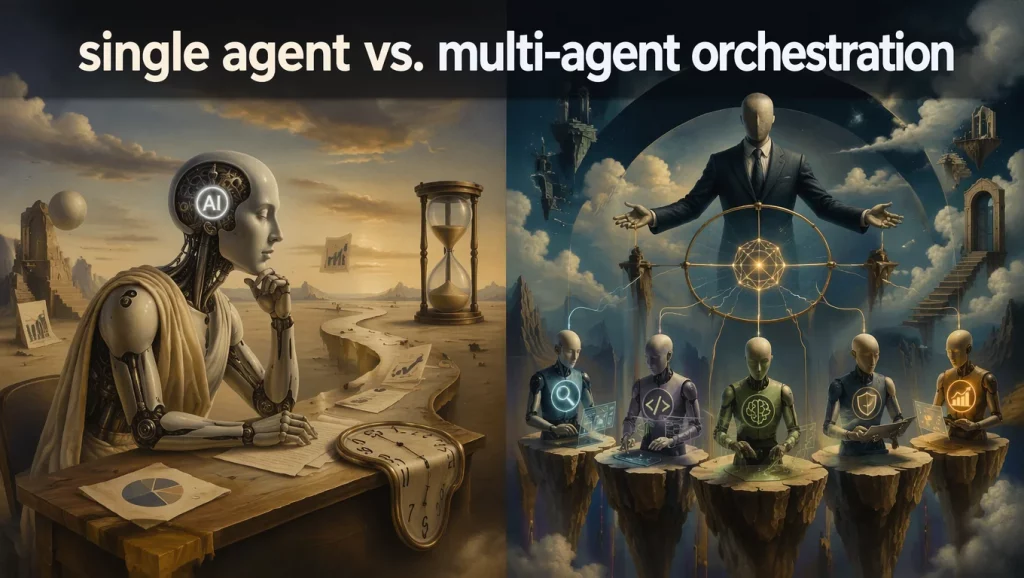
The table below maps the key decision dimensions. Pay attention to the “best fit” row – that’s usually where teams mis-select their architecture. For a deeper look at how these patterns play out in financial services and healthcare, see our AI agent orchestration platform overview.
| Dimension | Single-Agent System vs. Multi-Agent Orchestration |
| Task type | Bounded, repeatable, single domain – Complex, multi-step, cross-functional |
| Complexity | Low to medium – Medium to high |
| Latency | Lower (one model call per response) – Higher (inter-agent communication adds overhead) |
| Failure blast radius | Contained to one agent – Can cascade without proper error handling |
| Scalability | Linear: scale the one agent – Modular: scale only bottlenecked agents |
| Governance overhead | Simple – Requires audit logging per agent and per handoff |
| Best fit | FAQ bots, document classifiers, single-function automations – Enterprise workflows: KYC + compliance + CRM in one orchestrated flow |
What Are the Four Core Multi-Agent Orchestration Patterns?
No single architecture fits every enterprise scenario. Choosing the wrong pattern is the most common architecture mistake at the multi-agent level, according to Azure Architecture Center’s enterprise agent design guidance. The four patterns below each make different tradeoffs around control, scalability, and failure tolerance.
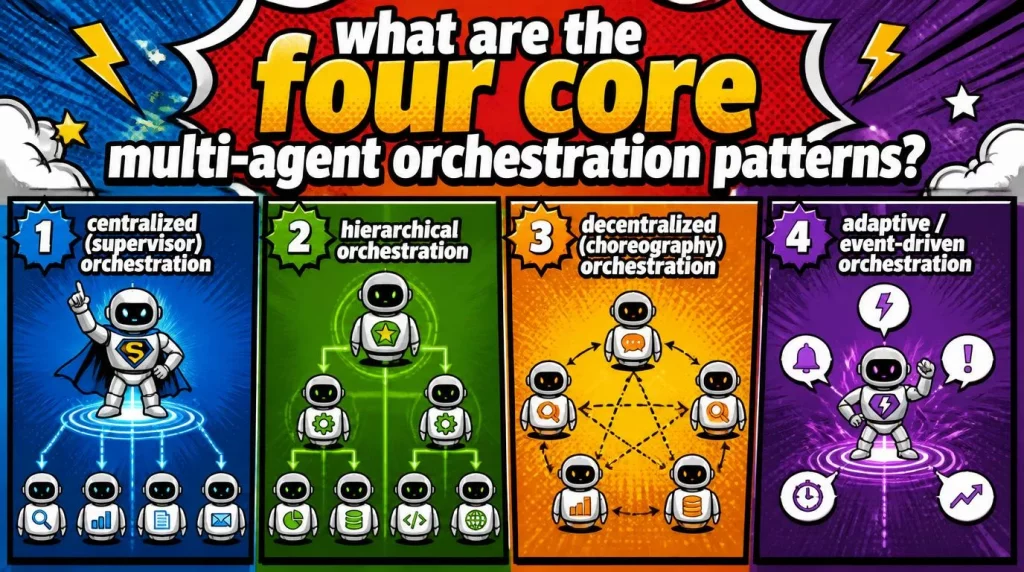
1. Centralized (Supervisor) Orchestration
A single orchestrator agent receives all tasks and directs specialized sub-agents. The orchestrator retains full visibility, making it straightforward to audit, debug, and enforce governance policies. Most enterprise deployments start here – it’s the most predictable.
Use it when: You’re in a regulated industry (banking, healthcare, insurance) where you need a complete audit trail of every decision, or when your task sequence is mostly fixed.
Watch out for: The orchestrator becomes a bottleneck under high concurrency. At 500 concurrent users it can behave very differently from staging at 10. If it fails, the entire system stops. Build failover logic before you go live.
2. Hierarchical Orchestration
A top-level orchestrator delegates to sub-orchestrators, which manage their own agent clusters. Think of it as a management tree: a primary orchestrator delegates to a Finance Operations sub-orchestrator, which coordinates Payment, Reconciliation, and Reporting agents independently.
Use it when: Large-scale deployments with clearly separated domains – customer-facing and back-office workflows that each need semi-independent management while staying aligned to a shared goal.
Watch out for: Context loss between tiers. Every handoff between orchestrator levels is a point where information can be dropped. Context passing between levels needs explicit schema design, not assumption.
3. Decentralized (Choreography) Orchestration
Agents self-coordinate based on shared events or state, without a central controller. When Agent A completes its task, it emits an event that triggers Agent B. No single point of failure.
Use it when: High throughput in event-driven environments like logistics pipelines or real-time fraud monitoring, where latency and resilience matter more than tight central control.
Watch out for: Debugging is significantly harder. Tracing a failure across a choreographed system requires comprehensive logging from day one. Most teams underestimate this until they face their first production incident.
4. Adaptive / Event-Driven Orchestration
Agents adjust their behavior dynamically based on real-time conditions. An adaptive system might detect that a compliance check is running long and automatically re-route the workflow to a backup path without human intervention.
Use it when: Your workflow involves high variability in task complexity or depends on unpredictable external inputs – regulatory data feeds, third-party API availability, real-time market conditions.
Watch out for: Without explicit constraint boundaries, adaptive systems make locally optimal decisions that are globally non-compliant. An agent rerouting itself into an unapproved workflow path is a governance failure, not a feature.
How Does Multi-Agent Orchestration Work Step by Step?
Understanding the architecture is one thing. Watching it run through a real workflow is another. Here’s how a multi-agent orchestration system handles corporate banking client onboarding – a use case where five distinct domains must coordinate without losing the thread.
- Task decomposition: The orchestrator receives the high-level goal (“Onboard this corporate banking client”) and breaks it into discrete subtasks: document verification, AML screening, credit eligibility check, CRM record creation, notification dispatch.
- Agent assignment: The orchestrator routes each subtask to the best-equipped agent based on role definitions, tool access, and current load. A Document OCR Agent handles extraction. A Compliance Monitor Agent handles AML. A CRM Integration Agent writes the output.
- Context sharing: As each agent completes its task, it updates the shared context store. The Compliance Monitor Agent doesn’t re-request the client name from the original document because the OCR Agent already extracted and stored it. This is precisely where poorly designed systems break down.
- Parallel and sequential processing: Some tasks run in parallel – document checks and preliminary credit scoring can happen simultaneously. Others run sequentially because one agent’s output is another’s input. The orchestrator manages the dependency graph.
- Output aggregation and quality check: Once all agents complete their tasks, the orchestrator aggregates outputs, checks for conflicts or gaps, and either produces the final result or routes exceptions to a human review queue.
- Error handling and escalation: If an agent times out, returns a low-confidence result, or hits a decision outside its authorization boundary, the orchestrator routes the exception to the appropriate human or backup agent – rather than failing silently.
| The failures covered in the next section almost always occur at steps 3, 5, and 6 – the handoff points where context transitions between agents. These are the seams in the system. |
Where Does Multi-Agent Orchestration Deliver ROI? Real Enterprise Results
Multi-agent orchestration delivers measurable outcomes in industries where process complexity and data sensitivity intersect. The following results are from AI Hive production deployments.
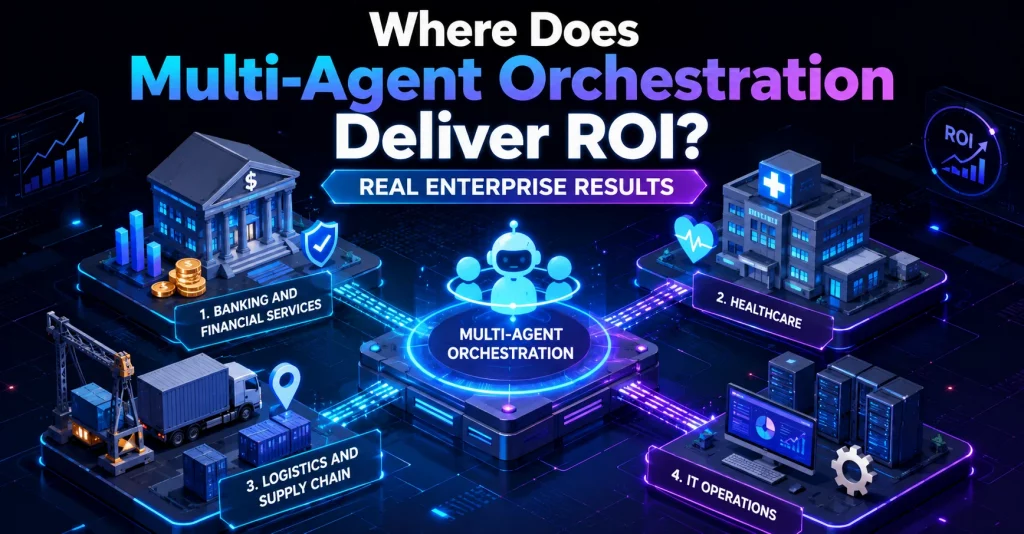
1. Banking and Financial Services
A regional banking group processing 15,000+ account applications per month deployed a KYC Onboarding Agent, an AML Watchlist Screening Agent, and a Compliance Monitor Agent under a centralized orchestration layer. KYC processing time dropped from 5 days to under 8 hours. The compliance team’s manual screening workload dropped by over 70%. The deployment ran entirely on-premise to meet data residency requirements across six countries. More details on architecture and compliance layers are available on our AI agent solutions for banking and financial services.
2. Healthcare
A private healthcare network with 120 clinics deployed three-agent orchestration covering patient triage, appointment management, and medical coding. Call centre wait times dropped from 18 minutes to under 3 minutes. The appointment no-show rate decreased by 34% because a dedicated Rescheduling Agent handled follow-up that previously fell through manual processes. HIPAA compliance and data de-identification requirements for this sector are covered on the healthcare AI deployment page.
3. Logistics and Supply Chain
A third-party logistics provider handling 50,000+ monthly shipments deployed a WISMO Resolution Agent and a Dispute Resolution Agent across WhatsApp, web chat, and email simultaneously. Before orchestration: 14-hour average email response time and 3.2 days per dispute. After deployment, 70% of WISMO queries resolved autonomously in under 2 minutes.
4. IT Operations
A manufacturing group with 4,200 employees deployed three-agent orchestration covering tier-1 helpdesk, access provisioning, and incident monitoring. The IT team’s ticket volume dropped by 55% within 90 days because password resets, VPN troubleshooting, and software provisioning no longer required human intervention.
| The consistent pattern: significant operational impact comes from agents that each handle one domain well under a unified coordination layer – not from a single agent attempting to handle everything. |
LangGraph vs. CrewAI vs. Microsoft Agent Framework: How Do You Choose?
If your team is building multi-agent orchestration in-house, you’ll encounter these three frameworks repeatedly. The framework landscape has shifted significantly since early 2025: Microsoft consolidated AutoGen and Semantic Kernel into the Microsoft Agent Framework (1.0 GA, April 2026). The original AG2 community fork continues as a separate project outside Microsoft. The table below reflects mid-2026 reality.
For a developer-level comparison of how these frameworks handle concurrent agents and observability, LangChain’s 2026 AI agent frameworks guide is worth reading alongside this section.
| Dimension | LangGraph | CrewAI / Microsoft Agent Framework |
| Architecture model | Graph-based stateful workflows | Role-based crews (CrewAI) / Unified orchestration (MAF) |
| Control style | Explicit, developer-controlled | Semi-autonomous role-driven (CrewAI) / Structured (MAF) |
| Best for | Deterministic enterprise workflows, compliance-sensitive processes | Collaborative knowledge tasks (CrewAI) / Azure-heavy enterprise (MAF) |
| Learning curve | Steeper – graph design knowledge required | Moderate (CrewAI) / Moderate-high (MAF) |
| Production maturity | High – used in regulated enterprise deployments | Medium-high (CrewAI) / High on Azure (MAF) |
| Governance & audit | Strong – explicit state management = traceable decisions | Moderate (CrewAI has role-token overhead) / Enterprise-grade on Azure (MAF) |
| Notable limitation | Requires upfront graph design investment | CrewAI: heaviest token footprint on repetitive tasks. MAF: edge cases outside Azure need extra validation |
For regulated industries: LangGraph is the strongest choice. Its explicit state management makes audit trails tractable – critical for BFSI, healthcare, and government. CrewAI works well for knowledge-work pipelines and content automation where role clarity matters more than execution granularity. Microsoft Agent Framework is the preferred path for Azure-heavy infrastructure.
Framework selection is only one layer of the decision. The orchestration control plane above the framework, the governance policies wrapping it, and the data architecture feeding into it often matter more. Our AI agent platform overview covers how AI Hive’s orchestration layer operates across model-agnostic, multi-framework deployments.
7 Ways Multi-Agent Orchestration Fails in Production – and What to Learn From Each
S&P Global’s 2025 Enterprise AI Survey found that 42% of companies abandoned most AI initiatives in 2025, up from just 17% in 2024. Gartner further projects that over 40% of agentic AI projects will be canceled by end of 2027 due to escalating costs, unclear business value, or inadequate risk controls. For a detailed breakdown of how these failure patterns play out across orchestration architectures, Dataiku’s enterprise orchestration analysis provides useful cross-industry context. The following failure modes are compiled from Gartner Peer Reviews, G2 enterprise AI reviews, and production post-mortems.
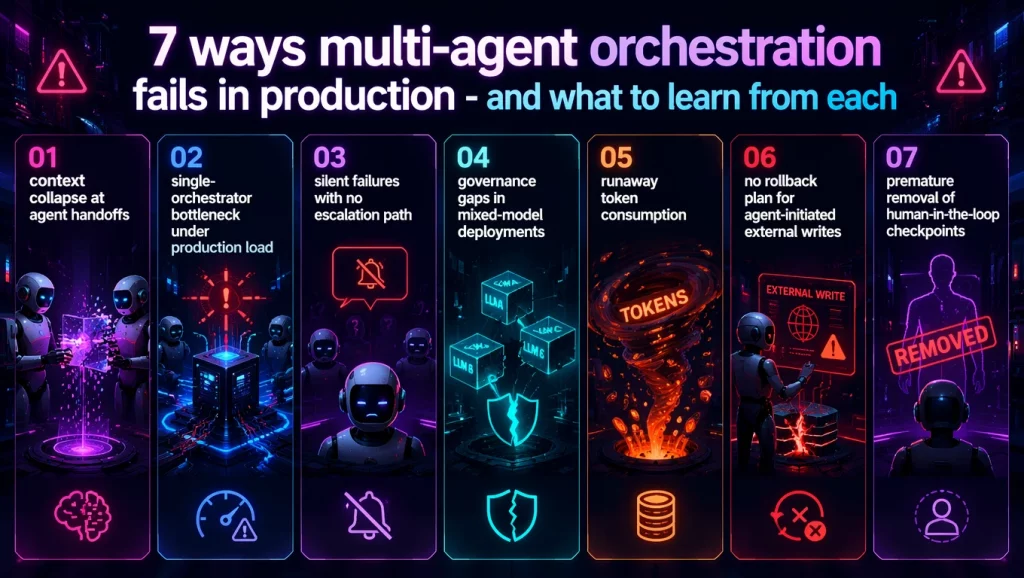
Failure #1: Context Collapse at Agent Handoffs
- The situation: An orchestrator passes a task to a sub-agent but sends only a task ID, not the context the sub-agent needs. The sub-agent fills in the gaps incorrectly, and errors compound downstream before anyone notices.
- The lesson: Every agent handoff must include an explicit context payload defined in your schema before you write the first agent. Context schema design is not a later step – it’s a prerequisite.
Failure #2: Single-Orchestrator Bottleneck Under Production Load
- The situation: A centralized supervisor architecture works flawlessly in staging with 10 concurrent users. At 500 concurrent users in production, the orchestrator becomes the throughput constraint and response times collapse.
- The lesson: Load-test your orchestrator at 3x expected peak traffic before launch. If it can’t sustain load, either shard horizontally or shift to a hierarchical pattern before go-live.
Failure #3: Silent Failures With No Escalation Path
- The situation: An agent returns a low-confidence result. The orchestrator accepts it without checking against a confidence threshold. The downstream output is wrong, but no human sees the exception – it just ships.
- The lesson: Every agent must return a confidence score or status flag with every response. The orchestrator must have explicit, tested rules for what constitutes an acceptable result. Anything below threshold routes to a human review queue.
Failure #4: Governance Gaps in Mixed-Model Deployments
- The situation: An enterprise deploys GPT-4o for high-stakes agents and a locally-hosted Llama model for routine tasks. The two models have different context window limits, tool-calling behaviors, and output formats. The orchestrator wasn’t designed for this heterogeneity.
- The lesson: Standardize the interface layer between your orchestrator and all models before introducing model diversity. Each model should sit behind an abstraction layer that normalizes its I/O format.
Failure #5: Runaway Token Consumption
- The situation: Agents pass full conversation history to every downstream sub-agent. A workflow through 10 agent hops multiplies token consumption by 10x versus the budget. The cost spike surfaces in month two’s invoice.
- The lesson: Design context compression rules from day one. Pass only what the receiving agent actually needs. In our experience across production deployments, intelligent context compression consistently reduces LLM costs by 35-60% compared to naive full-history passing.
Failure #6: No Rollback Plan for Agent-Initiated External Writes
- The situation: An autonomous agent writes a record to a CRM, sends a customer notification, and updates an inventory system – all before a downstream compliance check fails. Rolling back three external systems simultaneously is far harder than expected.
- The lesson: For any agent action that writes to an external system, design the rollback mechanism before designing the action itself. Treat agent-initiated writes as database transactions: atomic and reversible by design.
Failure #7: Premature Removal of Human-in-the-Loop Checkpoints
- The situation: Leadership saw the demo, got excited about full autonomy, and pushed to remove human review steps to “maximize efficiency.” Six weeks into production, edge cases the system wasn’t handling correctly had compounded into an operational problem.
- The lesson: Autonomy is earned incrementally, not granted at launch. Keep human review on every exception class at go-live. Remove review steps only after data shows the agent handles that exception class correctly at 98%+ accuracy over at least 30 days in production. Gartner’s April 2026 survey of 782 I&O leaders found that 57% have experienced at least one AI initiative failure – premature autonomy removal is one of the top cited causes.
Multi-Agent Orchestration Best Practices: What to Decide Before You Build
The decisions you make before writing any code typically determine whether a deployment reaches production or stalls at POC. According to McKinsey’s 2025 AI survey, organizations reporting significant financial returns are twice as likely to have redesigned end-to-end workflows before selecting modeling techniques.
- Define your goal at the task level, not the department level. “Automate our customer service” is not specific enough. “Resolve tier-1 queries autonomously across WhatsApp and email, escalating when confidence falls below 85%, within a 90-second SLA” is.
- Map data sources and access controls before you map agents. If your compliance data lives behind a different access control policy than your customer CRM, design agent-level permissions first. Retrofitting access controls after agents are built is significantly more expensive.
- Build for failure cases first, not the happy path. The scenarios that kill production deployments are edge cases: an external API returning a 503, two agents producing conflicting outputs, a request that falls outside every agent’s defined scope.
- Know when not to use multi-agent orchestration. Avoid it when your workflow is linear with no meaningful branching, when your team can’t debug distributed agent behavior in production, when your data infrastructure is too immature for reliable shared context, or when an incorrect autonomous decision costs more than keeping a human in the loop.
- Plan your governance layer before your agent layer. Every enterprise deployment needs audit logging, confidence thresholds, escalation rules, and data access controls – not as features you add later, but as the foundation the agents run on. AI Hive’s platform security documentation and enterprise implementation framework cover how these governance layers are structured across cloud, hybrid, and on-premise deployments.
Conclusion
Multi-agent orchestration is not a silver bullet – it’s a discipline. The patterns covered in this guide (centralized, hierarchical, decentralized, adaptive) each suit a different operational context. The architecture choice, governance layer, and failure-case design must come before the first agent is written, not after the first incident. For CTOs and Innovation Managers evaluating a deployment right now: start by mapping your workflow at the task level, audit your data infrastructure for shared-context readiness, and pick the orchestration pattern that matches your governance constraints – not the one that looked most impressive in the vendor demo.
AI Hive’s enterprise AI agent platform is purpose-built for exactly this transition – from orchestration design through governed production deployment, across cloud, hybrid, and on-premise environments. Our implementation framework covers the full journey: architecture selection, data readiness assessment, governance setup, and agent deployment. If you’re ready to move from pilot to production, get in touch with the AI Hive team to map your use case and define the right orchestration approach for your stack.