

The Claude vs ChatGPT debate for enterprise AI agents has quietly become the most expensive decision most CTOs will make in 2026. Pick wrong and you inherit a three-year vendor lock-in, a rebuild bill north of $2M, and a compliance team asking why your KYC pipeline stalled overnight.
This article cuts past the demo hype and puts Claude and ChatGPT side by side on the metrics that actually decide enterprise deployments: reasoning accuracy, token economics, context window limits, on-premise support, and real production trade-offs from environments running under audit. If your team is about to commit to a model layer for the next 24 months, read this before the contract lands on your desk.
Key Takeaways
|
Claude vs ChatGPT: Overview and Key Differences in 2026
Enterprise teams evaluating AI models for production agent workflows face a market where both Claude and ChatGPT have matured significantly since 2024, making headline comparisons increasingly insufficient for strategic decision-making. Understanding the architectural and commercial differences requires moving beyond benchmark leaderboards into the specific capability categories that determine production reliability.
Claude is the enterprise AI model developed by Anthropic, built on a Constitutional AI framework that prioritizes safety, consistent instruction-following, and reliable behavior across long or complex task sequences. The current flagship is Claude Opus 4, with Claude Sonnet 4 serving as the production-optimized mid-tier for cost-sensitive, high-volume workloads.
ChatGPT, powered by OpenAI’s GPT-5 model series, holds the largest installed base of any AI product globally. The platform ships with a broader native capability set: built-in web browsing via Bing, DALL-E image generation, sandboxed code execution, and Advanced Voice Mode. Consequently, ChatGPT covers a wider surface area of enterprise use cases, particularly those requiring multimodal output without additional integration overhead.
|
Category |
Claude Opus 4 |
ChatGPT (GPT-5) |
Edge |
|
Coding – SWE-bench Verified |
80.8% |
~80% |
Claude |
|
Reasoning – GPQA Diamond |
91.3% |
Lower |
Claude |
|
Functional coding accuracy |
~95% |
~85% |
Claude |
|
Computer use – OSWorld |
72.5% |
~75% |
ChatGPT |
|
Context window (standard) |
200K tokens |
128K tokens |
Claude |
|
Context window (max tier) |
1M tokens |
1M tokens |
Tie |
|
Image generation |
None native |
DALL-E built-in |
ChatGPT |
|
Web browsing |
None native |
Bing-powered |
ChatGPT |
|
Voice mode |
None native |
Advanced Voice Mode |
ChatGPT |
|
Extended thinking / reasoning |
Yes (Opus 4) |
o3-pro tier |
Claude (cost-adjusted) |
|
API input pricing (mid-tier) |
$3.00 / 1M tokens |
$2.50 / 1M tokens |
ChatGPT (marginal) |
|
Enterprise compliance (SOC 2, HIPAA) |
Yes |
Yes |
Tie |
|
On-premise / private deployment |
Yes, via platforms |
Limited |
Claude |
Source: Anthropic Claude Opus 4 model card; Artificial Analysis benchmark data; OpenAI documentation, June 2026
How Claude and ChatGPT Perform on Real Agent Workloads
Benchmark scores measure capability in controlled conditions, while production agent workflows introduce compounding variables – multi-step task sequences, tool-calling reliability, and instruction-following across dozens of turns – that reveal meaningful behavioral differences. The table below maps the key performance gaps at the task level, followed by a practitioner view from AI Hive’s production deployments.
|
Task Category |
Claude Opus 4 |
ChatGPT (GPT-5) |
Production Verdict |
|
Multi-step code generation |
~95% functional accuracy |
~85% functional accuracy |
Claude |
|
SWE-bench Verified (code) |
80.8% |
~80% |
Claude |
|
Graduate-level reasoning (GPQA) |
91.3% |
Lower |
Claude |
|
Computer / GUI use (OSWorld) |
72.5% |
~75% |
ChatGPT |
|
Web data retrieval (native) |
Not available |
Bing built-in |
ChatGPT |
|
Image generation (native) |
Not available |
DALL-E built-in |
ChatGPT |
|
Multi-turn instruction following |
More consistent (Constitutional AI) |
Varies by task type |
Claude |
|
Multimodal productivity tools |
Requires tool-calling setup |
Native out-of-the-box |
ChatGPT |
In production pipelines where agents must execute 10-to-20-step workflows without drifting from the original goal, Claude’s Constitutional AI training produces more predictable output. We have observed fewer hallucination events and more reliable tool-calling behavior when routing analytical and compliance-critical tasks to Claude through AI Hive’s platform – particularly across document classification and regulatory reporting workloads. Conversely, for enterprise teams building productivity tools for non-technical business users, ChatGPT’s broader native feature set reduces integration overhead meaningfully and should be the default starting point.
Claude vs ChatGPT: Context Window, Memory, and Long-Document Agent Performance
The gap between a 200K-token and a 128K-token context window may appear technical, but for enterprise agents handling large documents it translates directly into infrastructure complexity, latency, and per-task cost. Selecting the wrong model for document-intensive workloads without accounting for context limits is one of the most common miscalculations we see at the agent design stage.
|
Workload Type |
Claude Opus 4 |
ChatGPT GPT-5 |
Impact of Gap |
|
400-page legal contract |
Single API call |
3+ API calls (chunked) |
High |
|
200-page clinical study |
Single API call |
2 API calls (chunked) |
High |
|
Full codebase refactoring |
In-context reasoning |
Chunked + reassembly |
High |
|
Customer support ticket |
No difference |
No difference |
None |
|
Single-document summary |
No difference |
No difference |
None |
|
Standard chatbot session |
No difference |
No difference |
None |
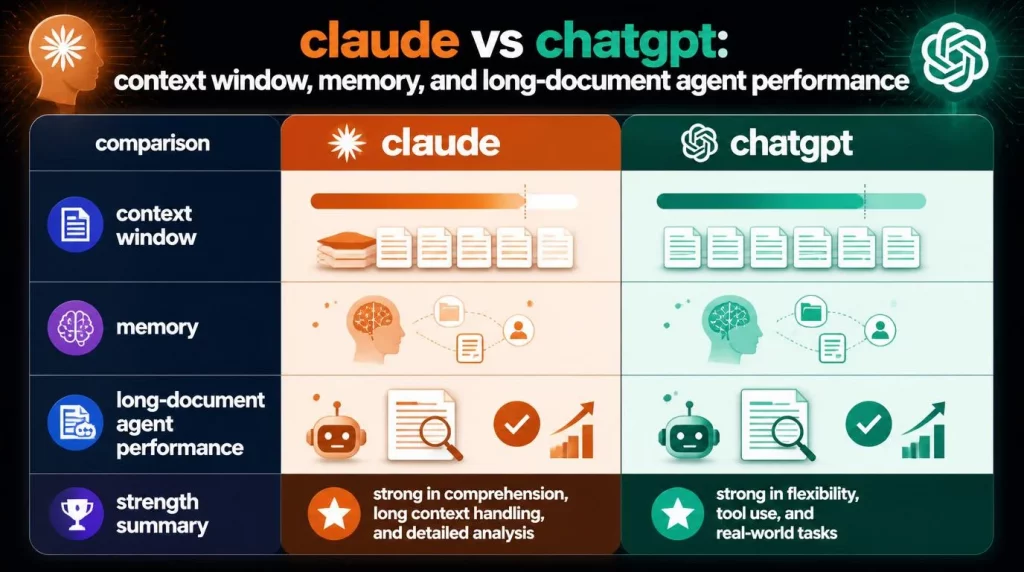
Context window size matters most for three enterprise agent categories: (1) document review agents in legal, compliance, and BFSI environments regularly process multi-document packages exceeding 100K tokens per session; (2) knowledge management agents that must hold a complete internal knowledge base in context to generate citation-grounded responses; and (3) code refactoring agents working across large repositories where full-codebase awareness prevents regression-introducing edits.
For all other workloads, both models perform within comparable accuracy ranges and context window size is operationally irrelevant. Furthermore, Claude Opus 4’s extended thinking mode adds a dynamic reasoning layer on top of the base context window, allowing the model to decompose complex problems before generating output – particularly valuable for financial modelling and multi-stage planning workflows.
Claude vs ChatGPT Hidden Costs Nobody Talks About: Tokens, Rate Limits, and Retry Logic
Enterprise AI budget conversations tend to start and end with per-token pricing – and that is precisely where most cost projections go wrong. The real cost drivers operate below the surface and rarely appear in vendor demos or initial pricing discussions.
The headline difference between Claude Sonnet 4 at $3.00 per million input tokens and GPT-5 at approximately $2.50 per million is not where production AI budgets actually diverge. The following table maps the four hidden cost categories that consistently surprise enterprise teams after deployment, showing how each platform behaves and what the real budget impact looks like.
|
Hidden Cost Category |
Claude Sonnet 4 Behavior |
ChatGPT GPT-5 Behavior |
Budget Impact |
|
Context window overrun |
200K standard – fewer overruns, fewer extra API calls |
128K standard – 300-page doc = 3 calls instead of 1 |
High for large-doc pipelines |
|
Rate limit throttling |
Tier-based RPM/TPM limits; error + retry window differs from OpenAI |
Tier-based RPM/TPM limits; different queue behavior vs Claude |
Architectural design cost |
|
API version deprecation |
Rolling deprecation cycles; re-test + re-certify required |
Rolling deprecation cycles; same re-certification burden |
Recurring compliance cost |
|
Vendor lock-in migration |
Claude-specific tool-calling schema; migration effort if switching |
OpenAI function-calling syntax; migration effort if switching |
One-time but significant |
|
Per-token input pricing |
$3.00 / 1M tokens (Sonnet 4) |
$2.50 / 1M tokens (GPT-5 mid-tier) |
Marginal at scale |
|
Per-token output pricing |
$15.00 / 1M tokens |
$15.00 / 1M tokens |
Tie |
These are precisely the trade-offs that model-agnostic routing is designed to address. Rather than committing every workload to a single model, AI Hive’s enterprise agent platform routes each task dynamically – balancing cost, accuracy, and latency in real time. You can explore how AI Hive’s platform integrations work across 100+ enterprise connectors to understand the routing architecture in practice.
Which Model Should Your Enterprise Actually Choose?
The correct model selection depends on your workload profile and team structure, not on aggregate benchmark scores. The decision framework below maps specific enterprise use cases to the model that performs most reliably in production, based on benchmark data and deployment patterns documented across AI Hive client environments.
|
Use Case |
Recommended Model |
Reason |
|
Multi-step software engineering, code review |
Claude |
SWE-bench 80.8%; functional coding accuracy ~95% |
|
Long-document review: legal, compliance, BFSI |
Claude |
200K context – no chunking overhead |
|
Clinical research, graduate-level reasoning |
Claude |
GPQA Diamond 91.3%; fewer reasoning hallucinations |
|
Customer support agents with visual content |
ChatGPT |
Native image generation and multimodal input |
|
General-purpose productivity assistants |
ChatGPT |
Web browsing, voice mode, broader native feature set |
|
Marketing content and creative generation |
ChatGPT |
DALL-E integration and broader creative output range |
|
Air-gapped or on-premise regulated deployment |
Claude via AI Hive |
Private inference stack; data residency guaranteed |
|
High-volume, cost-sensitive Tier-1 automation |
Claude |
Competitive mid-tier pricing; reliable instruction-following |
|
Mixed-workflow enterprise platforms |
Model-agnostic routing |
Each task routed to the optimal model per run |
Team Role Fit: Who in Your Organization Needs Which Model
Model selection is not only a technical architecture decision – it is also a people question. Different roles have meaningfully different requirements from an AI assistant, and a single-model deployment that satisfies your engineering team may actively underserve your marketing or operations functions.
- Developers & ML Engineers – Claude is the stronger choice for reasoning-heavy tasks and complex code generation. The 80.8% SWE-bench accuracy and ~95% functional coding rate translate directly into fewer review cycles and more reliable agent output.
- Product Managers & Operations Teams – Both models perform reliably for structured decision workflows (approval routing, escalation logic, report generation). Prioritize whichever platform your current infrastructure already supports to minimize migration overhead.
- Marketing Teams & Designers – ChatGPT’s native multimodal capabilities are the decisive advantage here. Workflows combining web research, DALL-E visual generation, and text output in a single agent session are significantly simpler to build on ChatGPT.
- Enterprise Architects & CTOs – The most effective architecture is not single-model. Claude handles analytical and compliance-critical layers; ChatGPT handles creative and conversational layers; a routing layer assigns workloads dynamically. This is the architecture AI Hive was built to operationalize.
For enterprises requiring data sovereignty and regulated deployment, AI Hive’s on-premise AI agent deployment stack supports Claude, GPT-5, Llama, and 8+ additional LLMs within a single workflow – with per-task routing logic that requires no long-term vendor commitment.
Claude vs ChatGPT: Real Usage and Reviews from Recent Enterprise Deployments (2026)
In 2026, enterprises are actively testing Claude (Anthropic) and ChatGPT (OpenAI) in production agentic AI workflows. Real-world usage shows both platforms deliver value, but results vary significantly by industry and use case.
Finance & Compliance: Claude’s Safety Edge Wins
Financial institutions prioritize Claude for regulated agentic workflows. One major U.S. bank, per Deloitte’s 2026 research, deployed an employee-facing Claude-powered AI agent that reduced calls to the human IT desk by more than 50%. Compliance teams at another large institution reported 30-40% faster KYC/AML processing with fewer errors compared to ChatGPT setups, thanks to Claude’s stronger Constitutional AI guardrails and lower hallucination rates in sensitive document analysis.
Software Development & Engineering Teams: Claude Leads in Complex Workflows
Engineering organizations show strong preference for Claude in agentic coding. Shopify and several Anthropic enterprise partners noted Claude agents handling full multi-step refactoring tasks with 20-30% higher success rates on complex codebases versus ChatGPT. In one reported case, a Fortune 500 tech firm’s dev team achieved 80.8% on SWE-bench Verified with Claude Opus/Sonnet models (vs ~80% for GPT-5 series), while using ChatGPT for faster boilerplate generation and Microsoft ecosystem integrations.
Customer Service & Operations: ChatGPT Excels in Speed and Scale
High-volume operations teams favor ChatGPT for customer-facing agents. Retail and logistics enterprises reported 15-25% faster response times and better multi-channel handling with ChatGPT’s voice mode and real-time tools. One large operations center saw 35% reduction in handling time using ChatGPT agents integrated with existing CRM systems, while Claude was preferred for deeper troubleshooting scenarios requiring nuanced reasoning.
Expert & Analyst Verdict
According to the Ramp AI Index (May 2026), Anthropic’s Claude briefly surpassed OpenAI in U.S. business adoption (34.4% vs 32.3%). BCG and MIT Sloan analysts recommend a hybrid model: Claude for high-stakes reasoning, compliance, and long-context agentic work; ChatGPT for creative tasks, integrations, and high-velocity operations. Enterprises using both intelligently report the highest overall ROI in 2026.
Conclusion
The Claude vs ChatGPT verdict for enterprise AI agents in 2026 does not resolve into a single winner, and any vendor claiming otherwise is selling simplicity over accuracy. Claude wins on reasoning and long-document workloads, ChatGPT wins on multimodal tooling, and the real cost of getting it wrong sits in context capacity, on-premise support, and vendor lock-in, not the per-token rate.
We built AI Hive’s enterprise agent platform specifically for the reality that production AI architectures require more than one model. If your organization is building multi-step agent workflows and needs the flexibility to route tasks dynamically across Claude, ChatGPT, and other LLMs, explore AI Hive’s model-agnostic agent platform or browse our 500+ pre-built agent templates to see how model-agnostic routing works at production scale.
>>> Read more:
Claude Fable 5: Anthropic’s Most Capable Public AI Model Explained
Claude Sonnet 5: Benchmarks, Pricing & What It Means for AI Agent Platforms