

Most enterprise AI projects follow the same arc. A promising pilot. Months of internal pressure to scale. Then a quiet cancellation. McKinsey research shows that while nearly two-thirds of enterprises have experimented with AI agents, fewer than 10% have scaled them to deliver measurable value. The culprits are rarely the AI models themselves. They are governance gaps, integration complexity, and the absence of a clear path from prototype to production.
This playbook is built for CTOs, CIOs, and Innovation Managers who are past the “should we deploy?” conversation. You already know AI agents work. What you need now is the framework to make them work in your environment, on your data, within your compliance constraints. We will cover architecture, deployment models, security gating, and change management – anchored throughout with real production deployments from AI Hive clients across banking, healthcare, and logistics.
Key Takeaways
|
What Is Enterprise AI Agent Deployment?
Enterprise AI agent deployment is the process of moving an autonomous AI system from a controlled prototype environment into live production – where it executes real business tasks, accesses enterprise data, and takes actions across systems without step-by-step human direction.
That last part matters. An AI agent doesn’t follow a fixed script. It reasons through goals, selects tools, retrieves data, evaluates results, and decides what to do next. That adaptability is what makes it valuable. It’s also what makes deployment significantly more demanding than launching a rule-based automation or a traditional chatbot.
Three terms get conflated constantly in enterprise conversations. Here’s the practical difference:
| System Type | What It Does | What It Cannot Do |
| Chatbot | Responds to queries using fixed logic or retrieval | Initiate actions, call tools, or adapt to novel situations |
| Copilot | Assists a human completing a task with AI suggestions | Operate without human direction or approval at each step |
| AI Agent | Receives a goal, plans steps, executes actions autonomously across systems | Guarantee correctness without governance and guardrail layers in place |
The enterprise qualifier adds one more requirement. A production enterprise AI agent connects to live business systems – CRM, ERP, databases, communication platforms – and operates within a compliance and governance framework that a proof-of-concept prototype never needs to touch. That’s the gap this playbook helps you cross.
For a broader overview of how enterprise AI agents work and where they fit within your technology stack, see our enterprise AI agent guide.
Why Most Enterprise AI Agent Deployments Stall Before Production
The failure rate is not a headline exaggeration. Only 11 to 14% of enterprise AI agent pilots ever reach production at scale. The other 86 to 89% are cancelled, deprioritised, or quietly shelved. The reasons are almost never what teams expect.
Deloitte’s 2025 Emerging Technology Trends study found that while 30% of organisations are exploring agentic AI and 38% are running pilots, only 14% have solutions ready to deploy and just 11% are actively using them in production. That four-to-one ratio between experimentation and execution is not a technology problem – it is an operational and governance problem.
From our own deployment work across BFSI, healthcare, and logistics, the patterns we run into most often are:
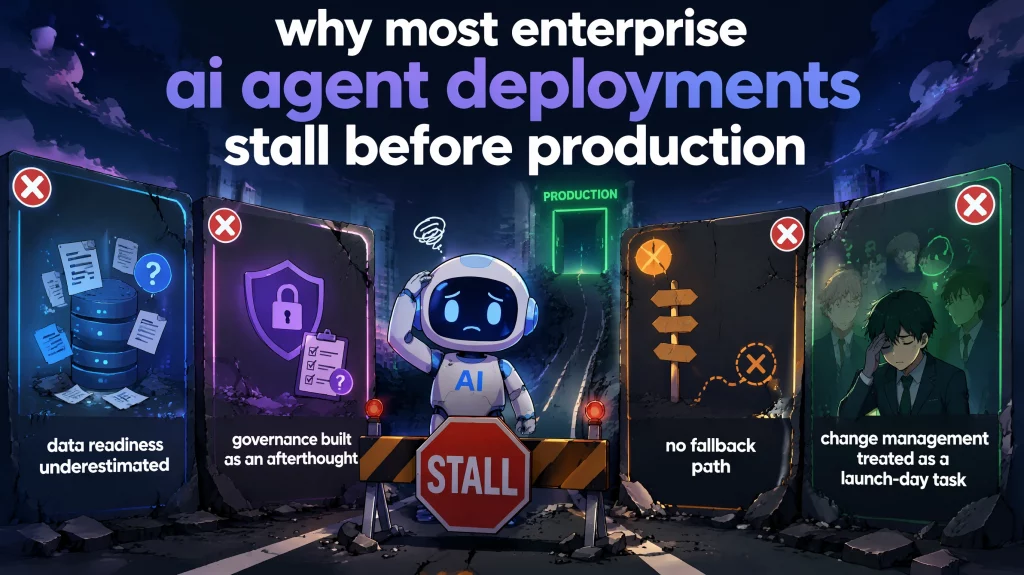
- Data readiness underestimated: Teams label their data as “ready” but arrive at integration with documents nobody trusts, CRM fields inconsistently filled, and retrieval layers quietly pulling from outdated sources. The agent produces outputs that look plausible but are wrong. Trust collapses before scale can begin.
- Governance built as an afterthought: Organisations launch pilots fast, skip audit logging and access controls, and then rebuild from scratch when compliance or legal flags the deployment. We’ve seen this delay production by four to six months in regulated environments.
- No fallback path: When the agent fails, what happens? If the answer is an error message with no next step, the deployment has a structural gap. Every production agent needs a defined degradation path: escalate to a human, fall back to a simpler workflow, or tell the user specifically what it can’t do.
- Change management treated as a launch-day task: Users who don’t understand why the agent escalates, what they’re responsible for reviewing, or when to override it will route around it. Agents ignored by users fail on adoption, not architecture.
| >>> IBM’s 2026 Institute for Business Value study found that 94% of enterprises now report AI sprawl is raising security risk and operational complexity. Ungoverned pilots are no longer just a waste of budget – they’ve become the dominant enterprise AI risk. |
The Six Phases of Enterprise AI Agent Deployment
A structured deployment framework doesn’t guarantee success. But the absence of one almost guarantees failure. What follows reflects how the AI Hive engineering team approaches production deployments – refined across more than 30 live deployments in financial services, healthcare, logistics, and manufacturing.
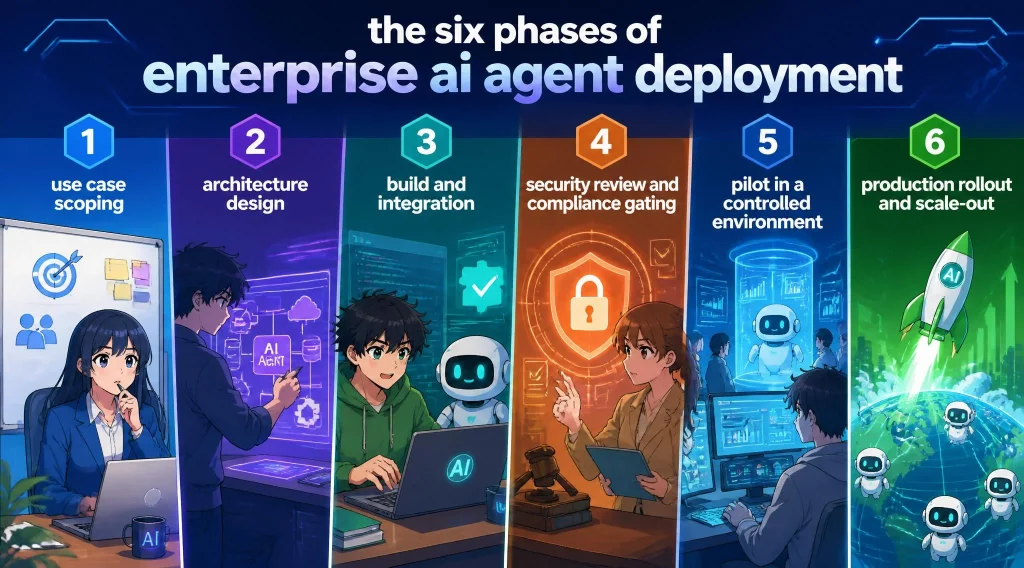
Phase 1: Use Case Scoping
This is the phase most teams underinvest in. It’s also the one that determines whether everything downstream succeeds or stalls.
A well-scoped first agent has three characteristics: high transaction volume (500 or more monthly events as a minimum), clear and consistent decision patterns (at least 80% of cases following known rules), and a measurable before-and-after metric – cycle time, cost per transaction, or error rate.
At this stage, map your data readiness honestly. Label each source as clean (structured, current, complete), improvable (repairable with labelling or normalisation), or unfit (don’t use until ownership and quality are resolved). Many deployments fail because the retrieval layer quietly pulls from documents nobody trusts.
Output: A one-page use case brief with a stated success metric, a data readiness map, and a defined deployment owner.
Phase 2: Architecture Design
Every enterprise AI agent has four layers. Getting the architecture wrong means debugging for months on issues that should have been design decisions from the start.
| Layer | What It Contains | Key Decision |
| Model Layer | The LLM driving reasoning (GPT-4o, Claude, Gemini, Llama, Mistral) | Data residency, cost-per-call, capability vs. compliance trade-off |
| Memory & Knowledge Layer | RAG pipeline, vector database, knowledge base connected to enterprise data | What sources the agent retrieves from, and how freshness is maintained |
| Tool & Action Layer | Connectors to business systems (CRM, ERP, ticketing, comms platforms) | Which actions the agent takes autonomously vs. which require human approval |
| Orchestration & Governance Layer | Workflow logic, guardrails, audit logging, escalation rules | This layer decides whether the agent reaches production. Without it, pilots stall. |
The orchestration and governance layer is where deployments that reach production diverge from those that don’t. It logs every decision, enforces guardrails, controls hallucination rates, and makes agent behaviour auditable. A banking agent reversing a wire transfer needs to log every step for compliance and escalate when confidence drops below a defined threshold. That doesn’t happen automatically – it has to be designed in.
If you’re evaluating whether to build or buy the agent architecture, our overview of enterprise AI agent development services covers the trade-offs between custom builds, platform-based deployments, and embedded engineering teams.
Phase 3: Build and Integration
This phase covers agent logic development, system integrations, and the RAG pipeline. Teams using AI Hive’s Agent Studio or a similar platform typically reach a testable prototype in under two weeks for standard use cases. Teams building from custom frameworks like LangChain or AutoGen should plan 10 to 16 weeks from kick-off to production rollout – with most of the variance driven by data access complexity, not model selection.
Key deliverable: A working agent connected to staging data sources, with tool-calling logic tested against a representative sample of real transactions.
Phase 4: Security Review and Compliance Gating
No enterprise AI agent should reach production without a formal security review. The non-negotiables before go-live: row-level security enforcement, credential encryption (AES-256 or equivalent), audit logging of every query and action, and confirmed data residency requirements. For regulated industries, GDPR, HIPAA, and sector-specific frameworks become architectural constraints – not checkboxes to tick after the fact.
At AI Hive, we build compliance gating into the deployment pipeline from day one for any client in banking, healthcare, or logistics. For on-premise deployments, this includes Kubernetes cluster configuration such that zero data leaves the client’s infrastructure post-deployment. The compliance review isn’t a final gate – it’s a continuous layer.
For a detailed breakdown of the security architecture required at this phase, including VPC isolation, RBAC configuration, and audit logging standards, see our guide to enterprise AI agent security.
Phase 5: Pilot in a Controlled Environment
A pilot is not a demo. It runs against real data, real users, and real transaction volumes – within a bounded scope. During the pilot, track: task completion rate, human correction rate, escalation rate, tool failure rate, average latency, cost per completed task, and user satisfaction. A single accuracy score is too blunt for an agent that takes actions in live systems.
The pilot also surfaces change management gaps. If users are routing around the agent or ignoring its outputs, the fix is rarely a model adjustment. It’s usually a communication or trust problem that needs solving before you attempt scale.
Phase 6: Production Rollout and Scale-Out
Scale should be staged, not simultaneous. A phased rollout by department, geography, or transaction type lets governance issues surface before they become operational incidents. Define explicit scale-out criteria – the pilot must sustain a target task completion rate for a defined period before rollout expands.
Post-production, the work shifts to monitoring, tuning, and deepening integration. The agents that deliver compounding value are the ones treated as live software products, not deployed-and-forgotten systems.
Choosing Your Deployment Model: A Decision Framework
The choice between SaaS, private cloud, and on-premise deployment is not primarily a technical decision. For most enterprise organisations in 2026, it’s a compliance decision. Getting it wrong means rearchitecting under pressure – often after a security review flags a cloud deployment in a regulated environment. Here’s how to decide before that happens.
| Criteria | SaaS (Managed Platform) | Private Cloud | On-Premise |
| Time to first agent | Days to 2 weeks | 2 to 4 weeks | 4 to 8 weeks |
| Data residency control | Shared responsibility with vendor | Configurable within your cloud tenant | Full – data never leaves your infrastructure |
| Infrastructure cost | OpEx (subscription) | OpEx + cloud compute | CapEx (hardware + ops) |
| Compliance fit | General data protection; audit trails via vendor | Configurable for GDPR, SOC 2 | Required for HIPAA BAA, strict AML, air-gapped environments |
| Best for | Speed, mid-market, non-regulated workflows | Regulated industries with existing cloud contracts | Banking, healthcare, manufacturing with data sovereignty requirements |
| AI Hive equivalent | AI Hive SaaS Platform | AI Hive Modular Implementation on private cloud | AI Hive On-Premise with Kubernetes cluster |
One pattern we see repeatedly: organisations in regulated industries choose SaaS for speed, hit a compliance blocker at the security review stage, and then face a replatforming decision under internal deadline pressure. If your organisation operates in banking, healthcare, insurance, or any sector with strict data residency requirements, resolve the compliance question first – before you pick a deployment model.
Enterprise AI Agent Deployment Readiness Checklist (2026)
Before committing to a deployment timeline, assess your organisation against these four dimensions. According to IDC, only 21% of enterprises fully meet the readiness criteria across all four areas. That gap is where most deployment failures originate.
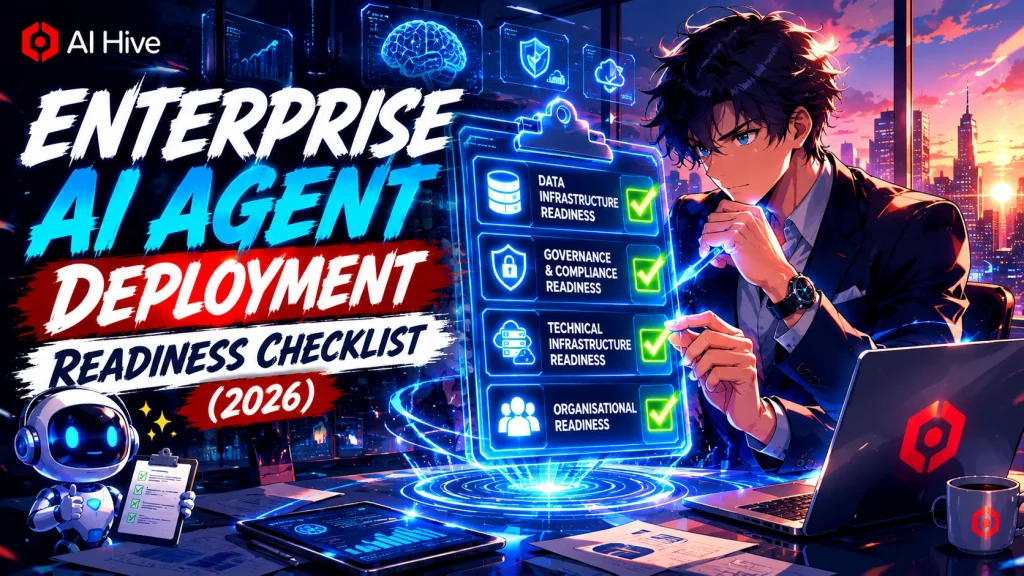
1. Data Infrastructure Readiness
- Core data sources identified and access permissions confirmed
- Data quality assessed per source: clean, improvable, or unfit
- RAG pipeline scope defined: which documents, databases, and systems will the agent retrieve from?
- Data freshness and update cadence mapped (stale retrieval is a leading cause of agent errors in production)
- PII fields identified and masking approach confirmed for any personally identifiable data the agent will access
2. Governance and Compliance Readiness
- Audit logging requirements confirmed with legal and compliance team
- Data residency requirements established – this determines deployment model
- RBAC scope defined: what can each user role ask the agent to do?
- Applicable compliance frameworks confirmed: GDPR, HIPAA, SOC 2, sector-specific requirements
- Human-in-the-loop thresholds defined: at what confidence level or action type does the agent escalate?
3. Technical Infrastructure Readiness
- API connections to target business systems tested (CRM, ERP, ticketing, communication platforms)
- Authentication method confirmed: OAuth 2.0, SAML 2.0, or SSO (Okta, Azure AD)
- Fallback path defined for agent failure: what happens when the agent cannot complete a task?
- CI/CD pipeline available for agent updates and rollbacks
- Staging environment available that mirrors production data access without live data
4. Organisational Readiness
- Internal deployment owner identified with clear authority
- Success metrics defined before build begins, not after pilot
- User-facing communication plan prepared: what does the agent do, why does it escalate, when should users override it?
- Training programme scoped for users who will work alongside the agent
- Budget confirmed for both build and ongoing maintenance – not just the initial platform cost
| Note from the field: The governance and organisational readiness dimensions are where most self-assessments overestimate. ‘We have audit logging’ often means logging exists somewhere but isn’t connected to the agent, isn’t monitored, and doesn’t meet what legal actually needs. Validate specifics – don’t assume coverage. |
Real-World Enterprise AI Agent Deployment: Three Production Cases
Abstract frameworks only carry so much weight. What follows are three deployments that moved from pilot to production, with the specific challenges, architecture choices, and outcomes.
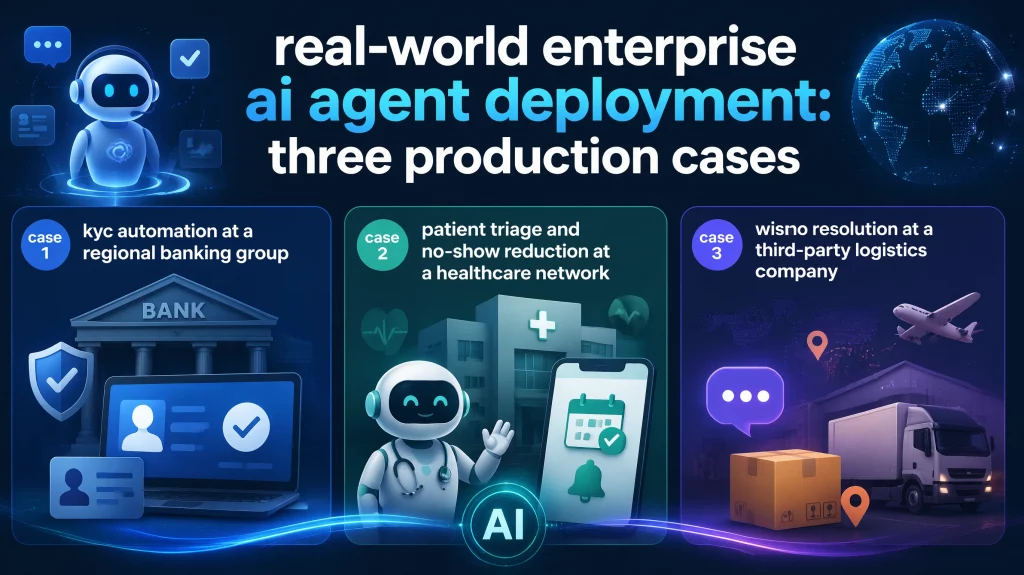
Case 1: KYC Automation at a Regional Banking Group (BFSI, On-Premise)
A regional banking group across six countries was processing 15,000+ account applications per month. KYC averaged five days per application. The compliance team spent over 50 hours per week on manual AML screening. Two countries required full data residency – which ruled out every cloud-based AI vendor.
We deployed two agents on a Kubernetes cluster inside the bank’s own infrastructure: a KYC Onboarding Agent handling document OCR, AML watchlist screening, and automated eligibility decisions; and a Compliance Monitor Agent covering transaction monitoring and regulatory reporting. Zero data leaves the bank’s infrastructure post-deployment.
Result: KYC processing time reduced by 78%. Manual AML screening hours dropped by over 60%. The data residency requirement that initially looked like a blocker became the deployment’s strongest internal argument: the bank could demonstrate to regulators that sensitive customer data never left its own systems.
The compliance architecture behind this deployment is documented in detail on the AI Hive BFSI solutions page, including the AML screening and KYC automation frameworks we use across regulated markets.
Case 2: Patient Triage and No-Show Reduction at a Healthcare Network (Healthcare, Cloud SaaS)
A national private healthcare network with 120 clinics and 800,000+ patients was running a call centre with 18-minute average wait times and a 34% appointment no-show rate. Clinical staff spent three to four hours per day on manual medical coding.
We deployed three agents: a Patient Triage Agent handling symptom assessment and appointment routing across chat and voice, available around the clock; a No-Show Reduction Agent managing automated reminders and rescheduling workflows; and a Medical Coding Assistant suggesting ICD-10 and CPT codes from clinical notes for coder review. Full HIPAA Business Associate Agreement required, which drove the infrastructure choice: private cloud with complete audit logging and end-to-end encryption.
Result: Call centre volume fell 60% within 90 days. The no-show rate dropped from 34% to below 20%. Medical coding time per encounter was cut approximately in half, with the remaining human review time focused on edge cases the assistant flagged.
Case 3: WISMO Resolution at a Third-Party Logistics Company (Logistics, Cloud SaaS)
A third-party logistics company handling 50,000+ monthly shipments across Southeast Asia was receiving 800 to 1,200 customer enquiries per day. 65% were “Where Is My Order?” queries. A team of 24 service agents was overwhelmed: email response times averaged 14 hours, dispute resolution averaged 3.2 days per case.
We deployed a WISMO Resolution Agent covering real-time shipment status and proactive delay notifications across WhatsApp, web chat, and email simultaneously, and a Dispute Resolution Agent handling automated claim intake, evidence collection, and policy-based settlement recommendations. Scoping to production: under four weeks.
Result: 87% of WISMO queries resolved without human intervention. Email response time dropped from 14 hours to under 2 minutes for automated cases. Dispute resolution fell from 3.2 days to under 6 hours for standard cases.
For additional production deployments across retail, manufacturing, and IT operations, see the full AI Hive case studies library.
Governance, Monitoring, and Scale-Out After Deployment
Governance doesn’t end at go-live. The deployments that deliver compounding value are the ones treated as live products: monitored continuously, tuned on production data, and expanded deliberately.
The metrics that actually matter in production are more granular than a single accuracy score. Track these from day one:
- Task completion rate: the percentage of tasks the agent resolves without human intervention
- Human correction rate: how often a human overrides the agent’s output (a rising correction rate is an early warning signal)
- Escalation rate: how often the agent escalates to a human, and whether the threshold is calibrated correctly
- Hallucination or unsupported-claim rate: tracked at the output level – not estimated from the model’s benchmark scores
- Cost per completed task: ensures the deployment’s economics stay sound as volume scales
Model-agnostic platforms add a useful lever here. On AI Hive’s platform, different agents within the same workflow can run on different LLMs: a high-stakes compliance decision routes to Claude or GPT-4o, while a routine status query routes to a faster, lower-cost model. This governance-first mindset is increasingly non-negotiable. Forrester’s Predictions 2026 AI report found that only 15% of AI decision-makers reported an EBITDA lift from their AI investments in the past 12 months – and cited poor AI literacy and absence of governance frameworks as the two primary reasons value isn’t landing.
For organisations operating under Vietnam’s AI Law 134/2025/QH15 (effective March 2026) or the EU AI Act, ongoing governance also requires documented audit trails, human-in-the-loop protocols for high-risk decisions, and periodic model performance reviews. The AI Hive platform security and governance documentation covers how we’ve implemented these requirements across regulated client environments.
Conclusion
Enterprise AI agent deployment in 2026 is not primarily a technology problem. The models are capable. The platforms are mature. The failure points are governance gaps, integration complexity, change management, and the absence of a structured path from prototype to production.
Organisations that address those four areas systematically – scoped first use case, compliant architecture, staged rollout – consistently reach production faster and sustain higher task completion rates than those treating deployment as a launch-day event.
If you’re ready to move from pilot to production, the next step is a 30-minute scoping call with our solutions engineering team. We’ll assess your use case, data readiness, and compliance requirements, and give you a realistic deployment timeline and architecture recommendation. Start the conversation with AI Hive’s implementation team. Or browse the AI Hive agent marketplace to see which pre-built agent templates are closest to your target use case.