


Enterprise AI agent security is now the top reason CISOs delay or block AI production rollouts. Teleport’s 2026 State of AI in Enterprise Infrastructure Security report – which surveyed 205 CISOs and security architects – found that enterprises granting excessive permissions to AI agents experience 4.5x more security incidents than those enforcing least-privilege controls. Yet 92% of those organizations already run AI in production infrastructure. The access gap, not the AI itself, is the crisis. This guide maps the five core threat vectors your security team must address before any enterprise AI agent reaches production, and lays out the architecture decisions that determine whether your deployment is defensible.
Key Takeaways
- Enterprise AI agents introduce five distinct threat vectors with no direct equivalent in traditional application security: prompt injection, data leakage, tool abuse, model poisoning, and hallucinated actions.
- Zero-Trust Architecture for AI agents means every agent action is re-authenticated as though it were a new user request – access granted five minutes ago is not access granted now.
- The NIST AI Risk Management Framework (AI RMF 1.0) with its 2025 companion document NIST AI 100-2e2025 is the primary compliance reference CISOs’ auditors will expect for enterprise AI deployments.
- On-premise deployment is not a preference for regulated sectors – in banking, healthcare, and government, it is often the only architecture a CISO can approve.
- Vietnam’s AI Law 134/2025/QH15, effective March 2026, introduces risk-based data residency obligations that make on-premise deployments a legal baseline for high-risk AI systems in Southeast Asia.
- Red-teaming an AI agent before production approval requires adversarial prompt injection tests, tool-boundary verification, and PII-exfiltration simulation – standard pentesting misses all three.
What Is Enterprise AI Agent Security?
Enterprise AI agent security is the set of controls, architectures, and governance practices that protect autonomous AI systems from exploitation, data exposure, and unauthorized action within enterprise environments.
The reason it needs its own discipline is that AI agents behave differently from the software your team has secured for the past two decades. They don’t execute fixed code. They interpret instructions, choose which tools to call, and make multi-step decisions autonomously. A firewall can’t block a hallucinated action. An intrusion detection system won’t flag a prompt injection hidden inside a support ticket. You need controls built specifically for these failure modes, not bolt-ons from your existing stack.
Gartner projects that 40% of enterprise applications will embed task-specific AI agents by the end of 2026, up from less than 5% in 2025. Most security teams are governing systems already in production before the governance framework is in place. If that describes your organization, the sections below tell you what to fix first.
For a broader introduction to how enterprise AI agents work and where they’re being deployed, see our enterprise AI agent overview.
The Unique Threat Surface of Enterprise AI Agents
Enterprise AI agents operate differently from the software your security team has governed before. They receive natural-language instructions, reason about how to complete a goal, select tools to call, and act across connected systems without a human approving each step. That autonomy is what makes them useful. It’s also what expands the attack surface in ways your existing controls weren’t designed for.
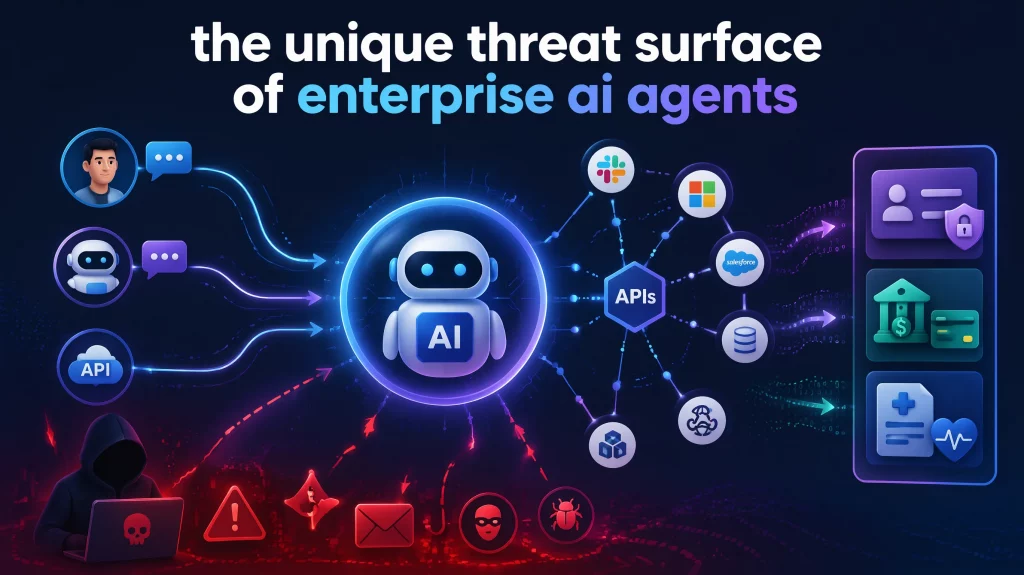
Three structural characteristics drive the risk:
- Dynamic interactions: Agents change behavior based on real-time input from users, upstream agents, and external APIs. Any of those input channels can be used to influence agent behavior maliciously – not just the user interface.
- Data handling: Agents retrieve, process, and sometimes store sensitive data including PII, financial records, and clinical notes. Any agent with read access to a CRM or ERP is a potential data exfiltration vector if output filtering is insufficient.
- Integration points: A single enterprise AI agent can connect to dozens of internal and external systems via APIs, webhooks, and MCP endpoints. Each connection is an entry point. The Barracuda Security report from November 2025 identified 43 agent framework components with embedded vulnerabilities introduced through supply chain compromise.
The practical implication: enterprise AI agent security can’t be added after deployment. It has to be designed into the agent’s architecture before the first integration is configured. The five threat categories below are where to start.
The Five Biggest Security Threats to Enterprise AI Agents in 2026
These five categories are the most commonly exploited vulnerabilities in enterprise AI agent deployments, based on CISO incident reports and security research through early 2026. Each operates at a different layer of the agent stack and requires distinct controls.
| Threat | How It Works | Primary Mitigation |
| Prompt Injection | An attacker embeds malicious instructions inside user input, a retrieved document, or a web page. The agent reads them as legitimate commands and overrides its original task. | Input validation, strict instruction hierarchy, sandboxed execution environment |
| Data Leakage | The agent surfaces PII, financial records, or confidential data outside authorized context – through insufficient output filtering or overly broad retrieval permissions. | PII masking at ingestion, RBAC, output filtering before every response is delivered |
| Tool Abuse | The agent is manipulated into calling external APIs, executing code, or modifying records with parameters it wasn’t designed to use. In multi-agent systems, a compromised downstream agent can escalate privileges upward. | Tool allowlisting, parameter validation, Just-in-Time (JIT) permission grants that expire after task completion |
| Model Poisoning | Training or fine-tuning data is corrupted to embed adversarial behavior triggered only under specific conditions. RAG knowledge-base poisoning is increasingly common – it affects production agents without requiring retraining. | Data provenance tracking, model integrity checks, AI Bill of Materials (AI-BOM), clean-room validation |
| Hallucinated Actions | The agent fabricates a result and acts on it – calling a non-existent API endpoint, citing a policy that doesn’t exist, or initiating a transaction based on a misread instruction. | Confidence thresholds, human-in-the-loop approval gates for high-stakes actions, mandatory audit trail before irreversible operations |
These threats don’t operate independently. A sophisticated attack can chain prompt injection with tool abuse to achieve data exfiltration that bypasses PII masking entirely. Your architecture needs to address each layer independently and as a system.
| ⚠️ The prompt injection attack most teams don’t think about until it’s too late:
The scenarios teams plan for – a malicious user typing attack instructions directly – are actually the easier ones to catch. What’s harder is indirect injection: a customer support agent retrieves a product review that a bad actor seeded with hidden instructions. The agent reads it as context, follows the embedded instruction, and leaks data or escalates a request it shouldn’t. We’ve seen this pattern in testing across multiple BFSI deployments. The fix isn’t user authentication – it’s treating every retrieved document the same way you treat untrusted user input: validate, sanitize, and never let it override the agent’s core instruction set. |
Zero-Trust Architecture: The Security Foundation for Enterprise AI Agents
Zero-Trust Architecture (ZTA) is the right baseline for enterprise AI agent security because it assumes breach by default. No agent, user, or system earns trust by being inside the network perimeter. Every request is authenticated. Every action is authorized. Every session is monitored. For AI agents specifically, that means treating every agent action as a new authentication event – not a continuation of a session granted five minutes ago.
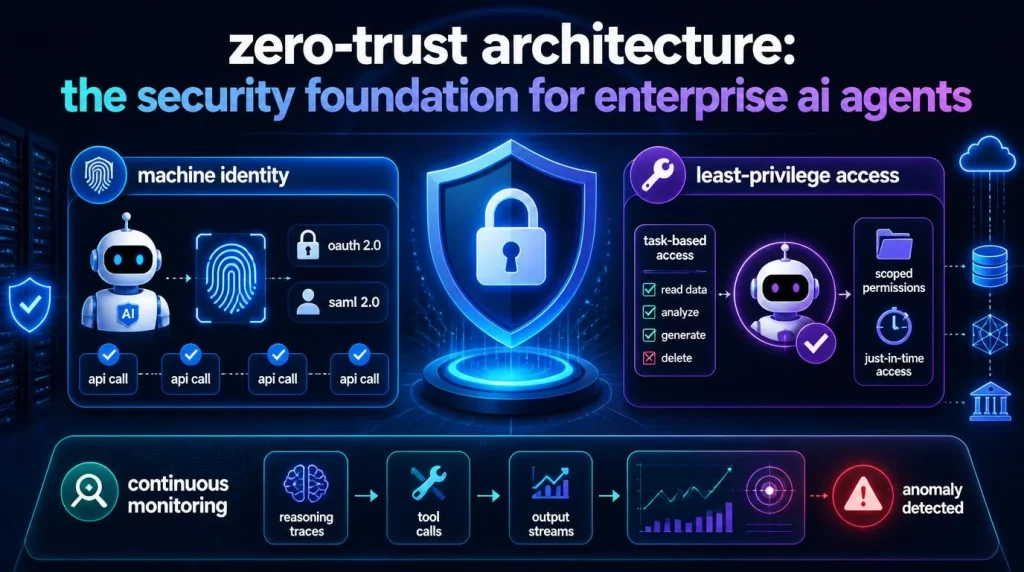
Three Core ZTA Controls for AI Agents:
There’s a confidence paradox worth naming here. According to the Vorlon 2026 CISO Report, which surveyed 500 U.S. security leaders, 89% of organizations claim strong OAuth token governance – yet 99% experienced at least one SaaS or AI ecosystem security incident in 2025. Confidence in policy is not a substitute for technical enforcement. Zero-Trust Architecture is the mechanism that closes that gap.
- Machine Identity: Every AI agent gets a unique, non-shared cryptographic identity. Authentication runs via OAuth 2.0 or SAML 2.0 on every API call the agent makes – not just at session start. Shared service accounts are the fastest path to a privilege escalation incident.
- Least-Privilege Access: Agents receive the minimum permissions for the specific task they’re executing right now. Permissions are scoped by task type, not granted globally at deployment. Just-in-Time grants expire automatically after the task completes.
- Continuous Monitoring: Agent reasoning traces, tool calls, and output streams are logged in real time. Anomaly detection flags deviations from baseline behavior – for example, an agent querying a data source outside its normal task scope.
There’s a confidence paradox worth naming here. According to the Vorlon 2026 CISO Report, which surveyed 500 U.S. security leaders, 89% of organizations claim strong OAuth token governance – yet 99% experienced at least one SaaS or AI ecosystem security incident in 2025. Confidence in policy is not a substitute for technical enforcement. Zero-Trust Architecture is the mechanism that closes that gap.
| 💬 What security architects say about ZTA and AI agents: “The mistake most teams make is applying Zero-Trust to the perimeter but not to the agent runtime itself. The agent gets in, and then it’s trusted forever. That’s not Zero-Trust – that’s a VPN with extra steps. Every tool call the agent makes should be evaluated the same way you’d evaluate a new login: who is asking, what are they asking for, and does that match what they’re supposed to be doing right now.” |
Overall, Zero-Trust is the foundation. What it doesn’t address is how agents handle sensitive data once they’re inside the perimeter – which brings us to PII.
Enterprise AI Agent Security and PII: Handling, Redaction, and Data Residency
Enterprise AI agents almost always touch Personally Identifiable Information. Customer support agents read account records. Healthcare triage agents process clinical notes. Financial agents surface credit histories. Without deliberate controls at each processing point, PII can appear in agent outputs, get retained in vector stores, or be transmitted to third-party model providers in plain text. None of those outcomes require a sophisticated attacker – they happen through misconfiguration.
Three PII Controls Every Deployment Requires:
- PII Masking at Ingestion: Identify and redact PII fields before they enter the agent’s context window or RAG knowledge base. Fields the agent doesn’t need to complete its task shouldn’t be visible to it.
- Output Filtering Before Delivery: Apply a second PII detection pass to every agent response before it’s returned to the user or passed downstream. This catches cases where the model reconstructs PII from multiple non-PII fields – a failure mode that input-side masking alone won’t prevent.
- Data Residency Controls: Ensure data processed by AI agents is stored and computed within jurisdictions that satisfy your regulatory obligations. This is non-negotiable for GDPR, HIPAA, and Vietnam’s AI Law 134/2025/QH15.
| 📋 A PII incident that didn’t make the headlines – but should have: During a post-deployment audit of a healthcare AI agent handling appointment scheduling, we found that the agent’s RAG knowledge base had been indexed with raw patient records that included full names, dates of birth, and insurance IDs – fields that weren’t needed for scheduling at all. The agent wasn’t leaking data to external systems, but it was surfacing that information in its responses to front-desk staff who had no clinical authorization to see it. The fix took four hours. Finding it took three months after go-live. PII masking at ingestion isn’t a security enhancement – it’s the baseline you should have shipped with. |
Data residency is where cloud-hosted AI platforms most frequently fall short for regulated sectors. When the model processing your data runs on shared infrastructure in an unspecified region, your compliance posture depends on the vendor’s assurances rather than your own controls. For organizations that can’t accept that dependency, on-premise deployment is the reliable architectural answer.
Mapping Enterprise AI Agent Security to the NIST AI Risk Management Framework
The NIST AI Risk Management Framework (AI RMF 1.0, published as NIST AI 100-1) is the primary U.S. federal reference for assessing and managing AI security risk. Its 2025 companion document, NIST AI 100-2e2025, extends governance to adversarial machine learning – explicitly covering prompt injection, RAG knowledge-base poisoning, backdoor installation, and multi-agent prompt propagation attacks. For any CISO preparing an enterprise AI agent deployment for audit, this is the vocabulary and control structure your auditors will arrive with.
The framework’s four core functions map directly to AI agent security practice:
| NIST Function | What It Requires | AI Agent Security Application |
| GOVERN | Establish policies, roles, and accountability structures for AI risk | Define who owns agent security decisions, set risk tolerance thresholds, and establish approval gates before any production deployment |
| MAP | Identify system context, data sources, stakeholders, and dependencies | Document every tool, data source, and external API the agent connects to; build an AI Bill of Materials (AI-BOM) |
| MEASURE | Monitor performance, trustworthiness, and risk outcomes continuously | Instrument agents to capture reasoning traces, tool call logs, and output quality metrics; set anomaly detection baselines |
| MANAGE | Prioritize, mitigate, and continuously monitor AI risks including third-party risks | Maintain a prioritized remediation backlog; update agent permissions as business context evolves; reassess after every model upgrade |
Organizations that align their enterprise AI agent security program with the NIST AI RMF gain a compliance advantage, but more practically they gain a cycle that surfaces security issues before they become incidents. The GOVERN-MAP-MEASURE-MANAGE loop is the difference between a security team that’s reactive and one that has actual sight lines into what its agents are doing.
| 💡 How to actually use the NIST AI RMF – not just cite it: Most organizations mention NIST AI RMF compliance in their AI governance policy and stop there. The teams that get real value from the framework use MAP as a living document: every time a new tool integration is added to an agent, it goes into the AI-BOM and gets assessed against the existing risk register before the integration ships. That sounds like process overhead, but in practice it’s a 30-minute review that has caught real problems – including one case where a proposed API integration would have given an agent write access to a billing system it had no business touching. The GOVERN function is only as good as what MAP feeds into it. |
Why On-Premise Deployment Is the CISO’s Answer for Regulated AI Agents
Cloud-hosted AI agent platforms offer a faster path to deployment. But they introduce a trade-off that CISOs in regulated sectors can’t make: your data and your agent’s reasoning leave your infrastructure. When the model processing your financial records or patient data runs on shared cloud infrastructure, your compliance posture depends on someone else’s controls, not your own.
AI Hive’s on-premise deployment puts that control back in your hands. When we deploy on your Kubernetes cluster, your data and model interactions stay entirely within your infrastructure perimeter. The platform enforces AES-256 encryption at rest and TLS 1.3 in transit, authenticates via SAML 2.0 and OAuth 2.0, and supports fully air-gapped deployments where no external network call is permitted after initial installation. That architecture satisfies the data residency requirements of GDPR, HIPAA, and Vietnam AI Law Article 13 without requiring you to trust a third party’s compliance assertions. Learn more about the full security specification on our platform security page.
| Deployment Model | Data Residency | Compliance Fit | CISO Approval Rate |
| Cloud SaaS (shared) | Data leaves your perimeter | Requires vendor BAA/DPA; geography not guaranteed | Low for regulated sectors |
| Private Cloud (VPC) | Data stays in your cloud region | Better; depends on cloud provider’s certifications | Moderate |
| On-Premise (Kubernetes) | Data never leaves your infrastructure | Full control; satisfies GDPR, HIPAA, VN AI Law Art. 13 | High for regulated sectors |
| Air-Gapped On-Premise | Zero external connectivity post-install | Strictest posture; required for defense, critical infrastructure | Preferred for highest-risk deployments |
Choosing the right deployment model is a foundational security decision, not a procurement preference. Once agents are in production and processing regulated data, changing the deployment model means a full migration. Get this right before the first integration goes live.
Validating Enterprise AI Agent Security: Audit Trails, Red-Teaming, and Continuous Testing
Standard penetration testing doesn’t cover the enterprise AI agent attack surface. A traditional pentest looks for network vulnerabilities, authentication bypasses, and injection flaws in deterministic code. AI agents are non-deterministic: the same input can produce different outputs across runs, and a vulnerability may only surface under specific prompt conditions that a standard test script never generates. Your CISO’s pre-production approval process needs a dedicated AI security validation track.
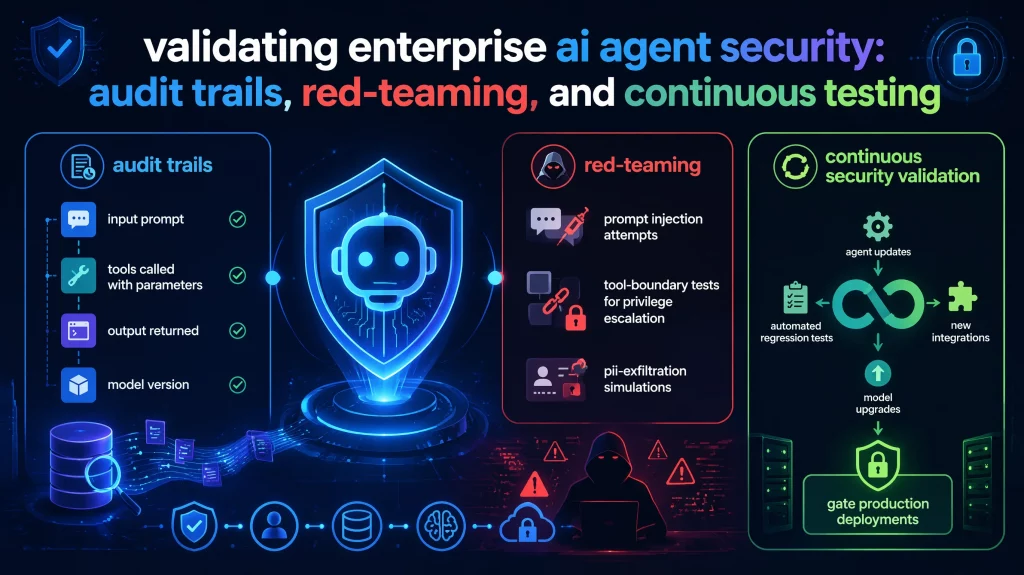
Three Validation Layers Before Production Approval:
- Audit Trails: Every agent interaction, tool call, and reasoning step must be logged with enough fidelity to reconstruct what happened after an incident. Logs need to capture the input prompt, the tools called with their parameters, the output returned, and the model version that produced it. Without this, post-breach forensics is guesswork.
- Red-Teaming: Adversarial testing must target AI-specific threat vectors: prompt injection attempts embedded in realistic user inputs, tool-boundary tests that probe for privilege escalation through chained tool calls, and PII-exfiltration simulations that verify whether output filtering catches reconstructed personal data. Standard pentest tools won’t generate these test cases automatically.
- Continuous Security Validation: Security posture degrades as agents are updated, integrations are added, and models are upgraded. Automated regression tests should replay your red-team scenarios after every change. Gate production deployments on passing these tests, not just functional QA.
The organizations that build agent inventories, privilege policies, and runtime controls before production rollout are the ones that avoid the incident reports. The ones that defer security validation to post-production monitoring are managing autonomous systems already operating outside their security team’s line of sight. For deployment architecture details that support these controls, see our guide on enterprise AI agent development services.
Vietnam AI Law 134/2025/QH15: What Southeast Asian CISOs Need to Know
Vietnam’s AI Law 134/2025/QH15, passed December 10, 2025 and effective March 1, 2026, is the first standalone AI legislation in Southeast Asia. For CISOs at organizations operating in Vietnam or processing Vietnamese citizen data, it introduces compliance obligations that directly affect how AI agents are deployed and governed. Global competitors who haven’t updated for this law are already behind.
The provisions most directly relevant to enterprise AI agent security:
- Article 13 – Risk-Based Classification: AI systems are classified as High, Medium, or Low risk. High-risk systems – including those processing financial data, health records, or government information – face the strictest data handling and residency controls. Most enterprise AI agents deployed in BFSI and healthcare will qualify as high-risk under this classification.
- Articles 34-35 – Grace Period: Most existing AI systems have a 12-month window from the March 2026 effective date to achieve compliance. Healthcare, education, and finance systems have 18 months. This is not an indefinite delay – organizations that haven’t started their compliance architecture now will face a compressed timeline and elevated regulatory risk.
- Article 20 – Investment Incentives: AI enterprises receive the highest tier of incentives under Vietnamese investment law. Compliant deployments get access to regulatory sandboxes, simplified procedures, and liability exemptions during testing – advantages that non-compliant competitors cannot access.
For organizations building AI agent deployments that must comply with Vietnam AI Law, on-premise deployment with full data residency controls is the most defensible architectural choice available today. It satisfies Article 13’s risk-based requirements without relying on a cloud provider’s interpretation of the law’s geographic scope.
Conclusion
Enterprise AI agent security isn’t something you layer on after deployment. The five threat vectors that matter – prompt injection, data leakage, tool abuse, model poisoning, and hallucinated actions – have to be addressed in the architecture before the first integration is configured. Zero-Trust Architecture gives you the control plane. NIST AI RMF gives you the audit structure. On-premise deployment gives you the data sovereignty that regulated sectors require. Red-teaming closes the gap between documented controls and demonstrated security.
For organizations operating under Vietnam’s AI Law or any regulated data framework, these aren’t optional steps – they’re the minimum viable security posture for enterprise AI agent deployments in 2026. Ready to assess your current posture? Talk to an AI Hive security architect and schedule a meeting today.