

Enterprise AI agents are reshaping how organizations automate decisions, manage workflows, and scale operations. According to the RAND Corporation’s 2025 enterprise AI research, 80.3% of enterprise AI projects fail to deliver their promised business value – a failure rate twice that of conventional software projects. McKinsey’s November 2025 State of AI survey, which polled 1,993 participants across 105 nations, confirmed the same pattern: 88% of organizations now use AI in at least one function, yet only 6% qualify as high performers with measurable enterprise-wide impact. This guide explains what a true enterprise AI agent is, how the underlying architecture works, which industries gain the fastest ROI, and how your organization can join that 6% by moving from pilot to production in under 90 days.
Key Takeaways
- 80% of enterprise AI projects fail before reaching production – and the root causes are consistently the same, predictable, and preventable.
- An enterprise AI agent and a chatbot share almost nothing beyond the word “AI.” Understanding the architectural difference is the prerequisite to any serious deployment decision.
- The 5-layer platform architecture determines whether your agent scales, stays compliant, and improves over time – or stalls at the proof-of-concept stage like most do.
- Industry ROI data is available, but the numbers only hold when three organizational conditions are in place before deployment begins. Most teams skip at least one.
- Build vs. buy vs. hire is not a philosophical debate – it is a cost and timeline calculation with a clear answer for most mid-market and enterprise organizations in 2026.
What Is an Enterprise AI Agent? (And Why It Is Not Just a Chatbot)
An enterprise AI agent is an autonomous software system that perceives data from its environment, plans a course of action, executes tasks across multiple integrated systems, and learns from outcomes to improve performance over time. Unlike a basic chatbot that responds to pre-scripted prompts, an enterprise AI agent handles end-to-end multi-step workflows with minimal human intervention.
The distinction matters enormously at the budget level. Chatbots and robotic process automation (RPA) tools can reduce repetitive task volume by 20-30%. Enterprise AI agents, by contrast, can automate complex decision chains – such as a loan application review that pulls credit data, validates identity against KYC rules, assesses risk, and generates an approval recommendation – in a single orchestrated workflow.
Enterprise AI Agent vs. Chatbot vs. RPA: A Side-by-Side Comparison
| Capability | Enterprise AI Agent | Chatbot | RPA |
| Decision complexity | High (multi-step reasoning) | Low (pattern matching) | Medium (rule-based only) |
| Learning capability | Yes (adaptive from outcomes) | Limited (static training) | No |
| System integration breadth | Broad (APIs, databases, LLMs) | Limited to chat interface | Specific process connectors |
| Handles unstructured data | Yes (documents, audio, images) | Partial (text only) | No |
| Compliance & auditability | Built-in governance layer | Minimal | Partial |
| Best use case | End-to-end workflow automation | Customer Q&A | High-volume data entry tasks |
The Four Core Capabilities of a True Enterprise AI Agent
- Perception is the agent’s ability to gather and interpret structured and unstructured data from multiple input sources – including documents, databases, APIs, sensor feeds, and real-time event streams. Without broad perception, an agent cannot operate outside a narrow data silo.
- Planning is the reasoning layer where the agent maps out a sequence of actions required to complete a goal. Advanced enterprise AI agents use chain-of-thought prompting and task decomposition to handle goals that require dozens of sequential steps.
- Action is the execution layer. The agent calls the right tools – database queries, API calls, LLM completions, code execution – in the correct sequence, handling errors and retrying where necessary without requiring human intervention at each step.
- Memory enables the agent to retain context from previous interactions, past decisions, and accumulated domain knowledge. Persistent memory transforms a stateless tool into an intelligent system that improves with use.
Together, these four capabilities separate enterprise AI agents from simpler automation tools. This is why the enterprise AI agent market is projected to grow to $47.1 billion by 2030, at a CAGR of 44.8% (MarketsandMarkets, 2025).
The 5-Layer Enterprise AI Agent Architecture
Understanding the architecture of an enterprise AI agent platform helps technology leaders evaluate whether a vendor’s solution can truly meet enterprise requirements. Most enterprise-grade platforms organize their capabilities into five distinct layers, each serving a specific function in the overall system.
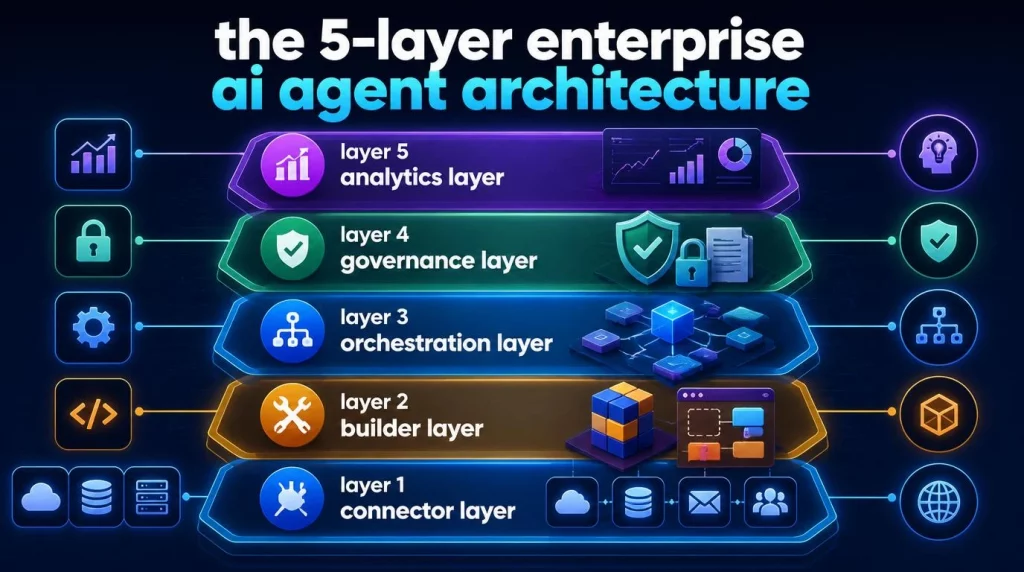
Layer 1: Connector Layer
The connector layer manages all integrations with external systems – ERP platforms, CRM databases, cloud storage, REST APIs, and real-time data streams. A mature connector layer provides pre-built connectors for 200+ enterprise systems, reducing integration time from weeks to days.
Layer 2: Builder Layer
The builder layer provides the development environment where teams design, configure, and test AI agents. Enterprise-grade platforms offer both a no-code visual studio for business users and a low-code SDK for developers, so organizations don’t create a single-team bottleneck.
Layer 3: Orchestration Layer
The orchestration layer coordinates multi-agent workflows – defining which agents run in parallel, which run sequentially, how results are passed between agents, and how exceptions are routed for human review. This layer is what separates point solutions from genuine enterprise AI platforms.
Layer 4: Governance Layer
The governance layer enforces data privacy rules, PII masking, access controls, and compliance policies across every agent interaction. For organizations operating in regulated industries, the governance layer must support frameworks including GDPR, SOC 2, HIPAA, and Vietnam’s AI Law No. 134/2025/QH15. You can review how AIHive’s enterprise AI security and compliance framework is structured – including SOC 2 Type II controls, GDPR data residency options, and on-premise deployment for regulated industries.
Layer 5: Analytics Layer
The analytics layer provides real-time observability into agent performance – task success rates, latency, cost per workflow, and human escalation frequency. This data allows operations teams to identify underperforming agents, optimize LLM routing, and measure ROI continuously.
>>> Why Model-Agnostic Infrastructure Prevents Vendor Lock-In?
A model-agnostic architecture allows an enterprise AI agent platform to route tasks to the most appropriate LLM – whether GPT-4o, Claude 3.7 Sonnet, Gemini 1.5 Pro, or an open-source Llama model deployed on-premise. Our clients who have adopted multi-model routing have reduced LLM inference costs by 35-60% compared to single-vendor commitments, while maintaining or improving output quality.
Vendor lock-in is not just a cost risk. When a single LLM provider experiences an outage or raises pricing, single-model deployments face immediate operational disruption. A model-agnostic enterprise AI agent platform absorbs these shocks automatically.
Business Benefits and ROI Data You Can Take to the Board
Enterprise AI agents deliver measurable financial returns within months, not years. According to McKinsey’s November 2025 State of AI survey, organizations that have moved beyond pilot to scaled deployment report meaningful EBIT impact – with high performers redesigning workflows end-to-end rather than automating isolated tasks. The following figures come from verified deployments across AIHive client engagements.
| Business Benefit | Metric | Industry Example |
| Faster process cycle time | 78% reduction in KYC processing time | Banking & Insurance |
| Reduced support volume | 60% drop in inbound call volume | Healthcare patient management |
| IT operations efficiency | 55% of IT support tickets auto-resolved | Manufacturing |
| Cost per transaction | Up to 40% reduction in cost per processed document | Legal contract review |
| Time to ROI | Positive ROI within 90 days of production deployment | Retail & E-commerce |
| Best use case | End-to-end workflow automation | Customer Q&A |
These numbers require a critical caveat: ROI depends on organizational readiness. Enterprises with clean data pipelines, defined success metrics, and executive sponsorship consistently reach positive ROI within 90 days. Those that skip the readiness assessment phase often spend the first three to six months resolving data quality issues rather than capturing value.
A Real Deployment Story: From 5-Day KYC to 4 Hours in a Regional Bank
One of our clients – a mid-sized commercial bank in Southeast Asia with approximately 1,200 employees – came to us with a classic problem. Their KYC onboarding workflow required a compliance officer to manually collect, verify, and cross-check identity documents across 4 separate internal systems. Each application took an average of 5 business days to process, and a compliance backlog of 300+ pending applications was building every quarter.
We deployed a KYC enterprise AI agent on AIHive’s platform using their existing on-premise infrastructure – a hard requirement from their compliance team. The agent connected to their core banking system, identity verification API, and internal risk-scoring database via the connector layer. Configuration and testing took three weeks. Production deployment happened on day 28.
Six months post-launch: average KYC processing time dropped from 5 days to under 4 hours. The compliance backlog cleared within 6 weeks. The bank’s compliance officers shifted from manual data entry to exception review – handling only the 8% of applications the agent escalated for human judgment. Total platform and implementation cost for year one: under $90,000. The bank’s conservative internal estimate put annual labor cost savings at over $340,000 – not counting the revenue impact of faster customer onboarding.
5 Common Enterprise AI Agent Use Cases by Industry
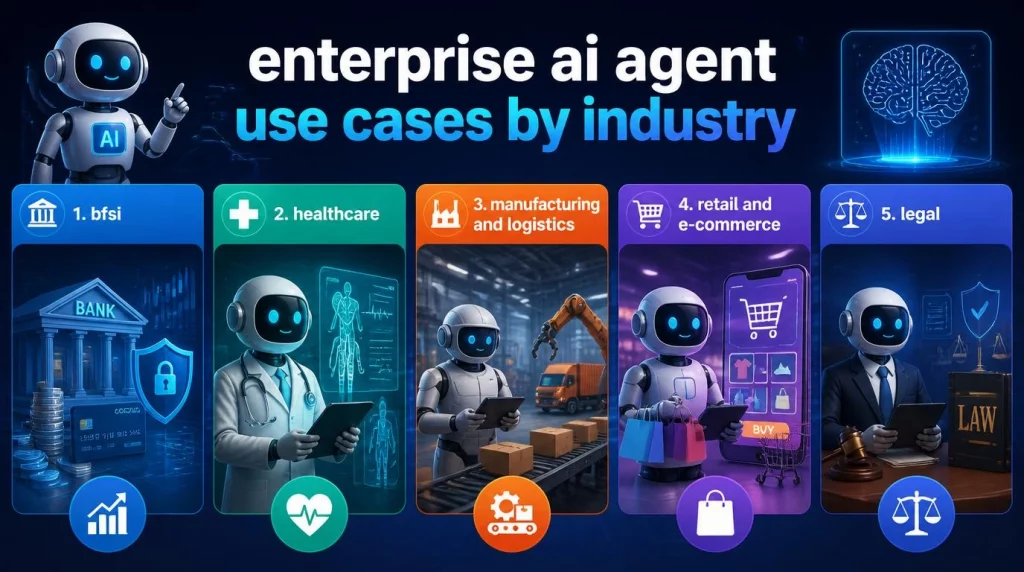
1. BFSI (Banking, Financial Services, and Insurance)
Financial institutions deploy enterprise AI agents to automate the most data-intensive, compliance-critical workflows in their operations. Our BFSI AI agent solutions cover the full spectrum – from automated KYC verification that reduces onboarding time from 5 days to 4 hours, to anti-money laundering transaction monitoring that flags suspicious patterns in real time, and loan application processing that integrates credit bureau data, income verification, and risk scoring into a single orchestrated workflow.
2. Healthcare
Healthcare organizations use enterprise AI agents to address the administrative burden that consumes up to 30% of clinical staff time, according to the American Medical Association. Agents handle patient intake classification, medical coding validation, prior authorization requests, and clinical trial documentation – freeing physicians to focus on direct patient care.
3. Manufacturing and Logistics
Manufacturers deploy AI agents for predictive maintenance scheduling, where the agent monitors equipment sensor data, cross-references maintenance history, and generates work orders before failures occur. Supply chain agents monitor inventory levels across global warehouses, identify supply disruption risks, and trigger reorder processes automatically – reducing stockouts by an average of 35% in our client deployments.
4. Retail and E-Commerce
Retail enterprises use AI agents to personalize customer experiences at scale – analyzing purchase history, browsing behavior, and inventory availability to generate product recommendations in real time. Pricing optimization agents monitor competitor pricing, demand signals, and margin thresholds to adjust prices dynamically, with some retailers reporting a 12-18% improvement in gross margin within six months.
5. Legal
Law firms and in-house legal teams deploy enterprise AI agents to automate contract review, reducing the average review time for a standard vendor agreement from 4 hours to 25 minutes. The agent extracts key clauses, flags deviations from standard templates, identifies missing provisions, and generates a redline summary – allowing attorneys to focus on negotiation strategy rather than initial document screening.
How to Evaluate and Choose an Enterprise AI Agent Platform
The enterprise AI agent platform market has expanded rapidly, and not all platforms deliver equivalent enterprise-grade capabilities. When evaluating vendors, technology leaders should assess five critical criteria before signing a contract.
- Deployment flexibility: Does the platform support cloud, on-premise, and private cloud deployment? Organizations in regulated industries – particularly BFSI in Vietnam and Southeast Asia – require on-premise deployment to comply with data residency requirements.
- Model agnosticism: Can the platform route tasks across multiple LLM providers without requiring a full re-architecture? Single-model platforms create long-term cost and resilience risks.
- Governance and compliance coverage: Which compliance frameworks does the platform support natively? Look for SOC 2 Type II certification, GDPR compliance documentation, and support for sector-specific frameworks like HIPAA or local AI regulations.
- Integration breadth: How many pre-built connectors does the platform offer? Building custom integrations from scratch for each enterprise system can consume 40-60% of total implementation time.
- Expert support model: Does the vendor offer AI engineering support beyond documentation? The most common deployment failure mode is not technical – it’s the absence of domain expertise during configuration and testing.
Build vs. Buy vs. Hire: Total Cost of Ownership Comparison
| Approach | Initial Investment | Time to First Agent | Ongoing Cost | Risk Profile |
| Build in-house | $500K – $2M | 9 – 18 months | High (talent retention) | Very High |
| Buy SaaS platform (heavy vendor) | $300K+ / year | 6 – 18 months | High (license fees) | Medium (vendor lock-in) |
| Buy lightweight tools | $20K – $80K / year | 2 – 4 weeks | Low initially (scales poorly) | High (compliance gaps) |
| AIHive (SaaS + AI Engineers) | $30K – $120K / year | 4 weeks to first agent | Predictable (transparent pricing) | Low (model-agnostic, on-premise option) |
Why 80% of Enterprise AI Projects Fail to Reach Production? – And How to Beat the Odds
The numbers are not ambiguous. According to McKinsey’s November 2025 State of AI survey, 88% of organizations now use AI in at least one function – yet only 6% qualify as high performers with measurable enterprise-wide EBIT impact. The gap between adoption and value is where most enterprise AI projects stall, and the failure modes follow entirely predictable patterns.
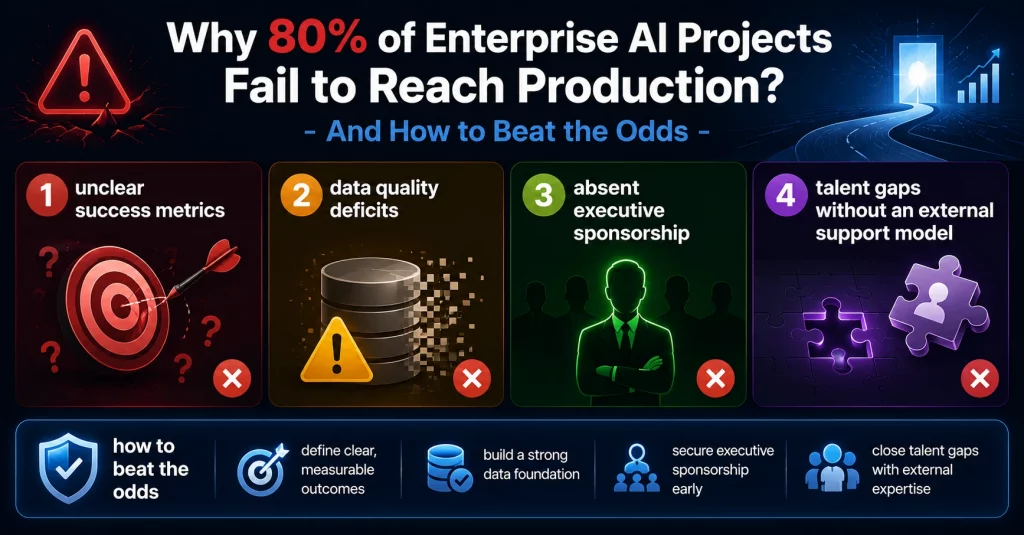
Failure Mode 1: Unclear Success Metrics
Teams launch pilots without defining what production success looks like – a specific accuracy threshold, a cost-per-transaction target, or a processing time SLA. Without a measurable definition of ‘done,’ pilots extend indefinitely. 73% of failed AI projects had no agreed definition of success before the project started, according to a 2025 MIT Sloan study. Your enterprise must establish binary success criteria before the pilot begins.
Failure Mode 2: Data Quality Deficits
Enterprise AI agents perform only as well as the data they process. Organizations with fragmented, unstandardized data across legacy systems cannot expect production-grade performance. Gartner’s 2025 research found that 60% of AI projects lacking AI-ready data will be abandoned through 2026. We recommend a 30-day data readiness assessment before committing to agent architecture, which we conduct as part of our onboarding process at AIHive.
>>> From Our Deployment Experience:
In our experience running AI readiness assessments across clients in banking, healthcare, and manufacturing, we consistently find the same issue: organizations underestimate how much time data preparation consumes. Of the 40+ enterprise AI deployments our team has supported, the ones that hit 90-day ROI targets shared one common characteristic – they completed a structured data audit before writing a single line of agent configuration. The ones that skipped it spent months debugging data pipeline errors instead of capturing business value.
Failure Mode 3: Absent Executive Sponsorship
AI deployments that lack a named executive sponsor with budget authority rarely survive the handoff from pilot team to operations. Cross-functional resistance – from IT security, legal, HR, and line-of-business owners – requires top-down authority to resolve. A successful enterprise AI agent program needs a sponsor at the CTO or CIO level who has accountability for production outcomes.
Failure Mode 4: Talent Gaps Without an External Support Model
According to Deloitte’s 2025 AI Talent Report, 68% of enterprise leaders identify AI talent shortage as their primary deployment barrier. Building an in-house AI engineering team takes 12-18 months and costs $800K or more annually in salaries alone. Our AI Engineers for Hire model at AIHive provides a dedicated team of certified AI engineers who embed with your team from day one – delivering your first production agent within four weeks, without the hiring overhead.
Implementation Checklist: Moving Your Enterprise AI Agent from Pilot to Production
The following checklist reflects the deployment methodology our team uses across client engagements. Organizations that follow all steps consistently move from signed contract to first production agent in 30 days.
- Define the primary use case and set binary success criteria (e.g., KYC processing time under 4 hours, accuracy above 97%).
- Complete a data readiness assessment to identify gaps in data quality, access, and structure.
- Select your deployment model: cloud SaaS for speed, on-premise for data sovereignty, or hybrid for regulated-plus-unregulated workflows.
- Configure your connector layer to integrate the required enterprise systems within the agent’s scope.
- Build and test your first agent in the Builder environment using your production data sample.
- Configure the Governance Layer: set PII masking rules, access controls, and compliance policy enforcements.
- Run a 2-week supervised pilot with a real user group, measuring against your pre-defined success criteria.
- Review Analytics Layer dashboards for latency, error rates, and cost-per-task.
- Promote to production after hitting success thresholds, and schedule a 30-day performance review.
Conclusion
The enterprise AI agent market is not a future trend – it is a present competitive advantage for organizations that move from experimentation to production. The evidence is consistent across McKinsey, RAND, and Gartner: most organizations are stuck in pilot purgatory, not because AI doesn’t work, but because they lack the infrastructure, governance, and engineering expertise to cross the production threshold. Your enterprise doesn’t need to choose between speed and governance, or between cost and capability. AIHive delivers all four: a model-agnostic, compliance-ready platform with 500+ pre-built agent templates, on-premise deployment options, and a dedicated team of AI engineers who build your first production agent in four weeks.
The 80% of AI projects that fail do so for reasons that are entirely preventable. The organizations that succeed share three characteristics: they start with a specific, measurable use case; they deploy on infrastructure built for enterprise governance; and they partner with teams who have done it before.
>>> Ready to deploy your first enterprise AI agent? Contact AIHive’s team of enterprise AI specialists to schedule a complimentary readiness assessment and see how your organization can reach production in 30 days.