

For years, the most powerful frontier AI models stayed locked behind closed doors – available only to a handful of vetted defense and cybersecurity partners. Claude Fable 5 changes that. Released on June 9, 2026, Fable 5 is the first Mythos-class model Anthropic has made broadly available, bringing state-of-the-art reasoning, autonomous coding, and long-context performance to developers and enterprises worldwide. This article explains exactly what Fable 5 is, how it compares to its restricted sibling Claude Mythos 5, what it excels at, and what it will cost your team to run.
AI Brief: Claude Fable 5
| • First public Mythos-class model: The same underlying weights as the restricted Claude Mythos 5 – now available to anyone via the Claude API. |
| • Strongest coding model publicly available: 80.3% on SWE-Bench Pro, 11 points ahead of the next competitor. Stripe completed a 2-month migration in a single day. |
| • Leads on knowledge work and vision: Top score on Hebbia Finance Benchmark, new SOTA on vision tasks including rebuilding apps from screenshots. |
| • Safety classifiers cover 3 visible domains: Cybersecurity, bio/chem, and distillation queries fall back to Opus 4.8 with user notification. A fourth mechanism silently degrades quality for distillation attacks – disclosed in the system card but controversial. |
| • Pricing: $10/M input, $50/M output – less than half the price of Mythos Preview. Fallback credit applies when Opus 4.8 takes over. |
| • 30-day data retention mandatory: Zero data retention is not available on Fable 5 or Mythos 5. Plan accordingly for compliance-sensitive deployments. |
| • Free on Pro/Max/Team plans until June 22: Usage credits required from June 23 until Anthropic restores it as a standard plan feature. |
What Is Claude Fable 5? The First Public Mythos-Class Model
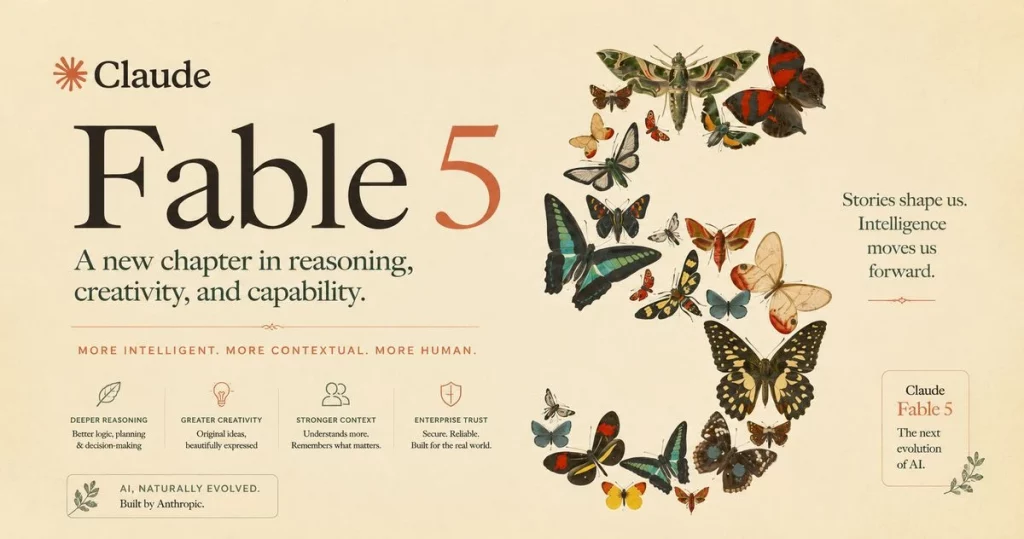
Claude Fable 5 is Anthropic’s most capable widely released AI model, designed for demanding reasoning, autonomous software engineering, and long-horizon agentic work. It belongs to the Mythos class – a tier that sits above Anthropic’s previous Opus class in both capability and risk profile.
The name ‘Fable’ is intentional. Anthropic derives it from the Latin fabula, meaning ‘that which is told’ – closely related to the Greek mythos. The two names signal that Fable 5 and Mythos 5 share the same underlying model. What distinguishes them is a set of safety classifiers built into Fable 5 that restrict certain high-risk query types. In short: same brain, different guardrails.
Mythos-class models represent a capability threshold where the risks of misuse become concrete enough to require active mitigation – particularly in cybersecurity and biology research. Fable 5 is Anthropic’s answer to the question: how do we release this level of power responsibly, at scale?
Claude Fable 5 vs. Claude Mythos 5: The Core Difference at a Glance
Fable 5 and Mythos 5 run on identical model weights. The difference lies entirely in access policy and safety architecture. The table below summarizes the key distinctions.
| Dimension | Claude Fable 5 | Claude Mythos 5 |
| Underlying model | Mythos-class weights | Mythos-class weights (identical) |
| Public availability | Generally available from June 9, 2026 | Restricted – Project Glasswing partners only |
| Safety classifiers | Active on cyber, bio/chem, distillation topics | Cyber classifiers lifted for approved partners |
| Fallback behavior | Falls back to Claude Opus 4.8 on blocked queries | No fallback needed – classifiers are lifted |
| API model string | claude-fable-5 | claude-mythos-5 |
| Pricing | $10/M input, $50/M output tokens | $10/M input, $50/M output tokens |
| Context window | 1M tokens default, up to 128k output | 1M tokens default, up to 128k output |
| Use case fit | General enterprise, coding, knowledge work | Cyberdefense, biomedical research, critical infra |
For a deeper analysis of use case fit between the two models, see our dedicated comparison: Claude Fable 5 vs. Claude Mythos 5 – Which Model Should Your Team Use?
Where Claude Fable 5 Excels: Core Capability Areas
Fable 5 leads across nearly every tested benchmark category. Below are the four domains where the performance gains are most commercially relevant.
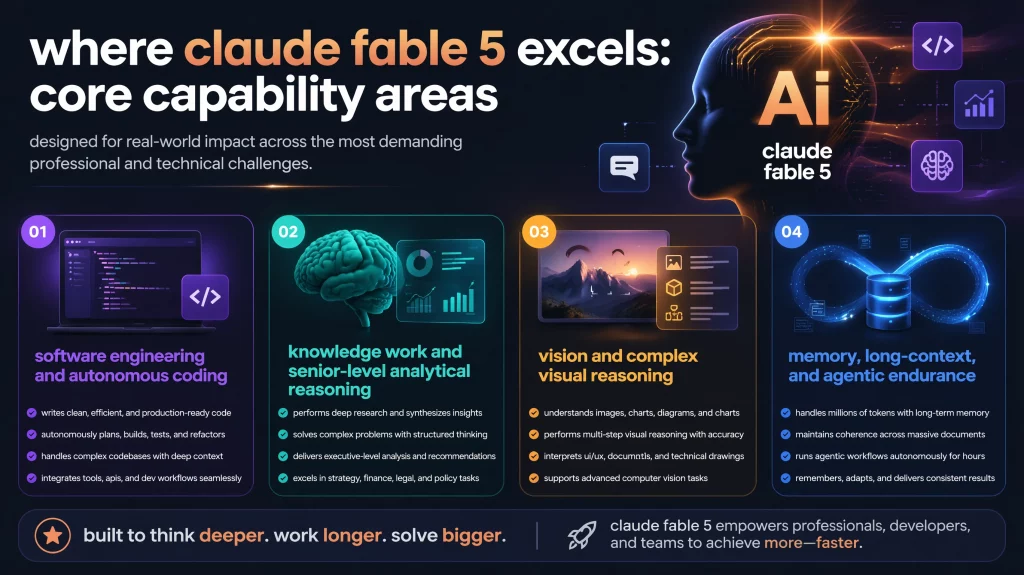
Software Engineering and Autonomous Coding
Fable 5 is currently the highest-scoring model on Cognition’s FrontierCode evaluation, which tests whether models can complete difficult coding tasks while meeting the standards of production-grade codebases. The eval rewards both correctness and token efficiency – and Fable 5 leads on both dimensions simultaneously.
In real-world testing, Stripe reported that Fable 5 compressed months of engineering work into days. Their team ran a codebase-wide migration across a 50-million-line Ruby codebase in a single day – a task that would otherwise have taken a full engineering team more than two months to complete by hand. Cursor’s CEO Michael Truell confirmed the model as the state of the art on CursorBench, describing Fable 5 as having ‘opened up a class of long-horizon problems that were out of reach for earlier models.’
For enterprise software teams, this is the most immediate source of ROI. Fable 5 can own entire refactoring projects, migration tasks, and code review cycles with a level of autonomy that previous Claude models could not sustain.
Knowledge Work and Senior-Level Analytical Reasoning
On Hebbia’s Finance Benchmark – designed for senior-level analytical reasoning – Fable 5 achieved the highest score of any model tested. The gains were concentrated in document-based reasoning, chart and table interpretation, and multi-step problem solving. IMC noted that Fable 5 performed near-perfectly across their trading-analysis evaluations, including factual lookup, conceptual reasoning, root-cause analysis, and expected-value analysis.
For enterprises in financial services, legal, or consulting, this means Fable 5 can reliably complete tasks that previously required senior analyst time: reviewing complex contracts, synthesizing research across large document sets, and generating structured outputs from raw data.
Vision and Complex Visual Reasoning
Fable 5 is Anthropic’s new state-of-the-art vision model. It can extract precise numbers from detailed scientific figures, rebuild a web application’s source code from screenshots alone, and execute complex vision-based tasks with minimal scaffolding. In benchmark testing, Fable 5 completed the entire game Pokémon FireRed using only raw game screenshots – no maps, no navigation aids – a task that required complex helper harnesses for earlier Claude models.
Memory, Long-Context, and Agentic Endurance
Fable 5 maintains coherence across millions of tokens and improves its own outputs using persistent notes. In testing on Slay the Spire (a strategy card game), providing Fable 5 with file-based memory improved its performance three times more than it improved Opus 4.8’s under the same conditions. Fable also reached the game’s final act three times more often – a proxy for sustained task completion on long-horizon objectives.
For agentic enterprise deployments, this translates into AI Agents that can run multi-day projects, recover from failures autonomously, and maintain context across large document repositories without losing coherence. AI Hive’s platform features – including multi-agent orchestration and persistent memory management – are specifically designed to leverage this capability tier at production scale.
How Claude Fable 5’s Safety Classifiers Work
Fable 5’s safety classifiers are separate AI systems that detect and intercept potentially harmful queries before the main model responds. When a classifier fires, the request automatically falls back to Claude Opus 4.8 – a highly capable model in its own right – rather than producing an outright refusal. Anthropic reports that more than 95% of Fable 5 sessions involve no fallback at all.
Three categories trigger the classifiers:
- Cybersecurity queries: Any request related to exploit development, offensive hacking, or defense evasion. Fable 5’s classifiers prevent the model from providing uplift on cyberattack tasks, while preserving its ability to assist with defensive security work.
- Biology and chemistry queries: Broad coverage of biological and chemical research topics, reflecting the dual-use nature of Mythos-class capabilities in life sciences.
- Distillation attempts: Requests flagged as large-scale efforts to extract Claude’s capabilities for training competing models – particularly in jurisdictions with inadequate AI safety oversight.
From a developer standpoint, these classifiers require handling a new API response type. When Fable 5 declines a request, the Messages API returns stop_reason: ‘refusal’ as a successful HTTP 200 response – not an error. Developers can pass the fallbacks parameter to have the API retry automatically on Claude Opus 4.8. Importantly, Anthropic does not bill for requests refused before any output is generated.
Claude Fable 5 Pricing and Token Economics
Claude Fable 5 is priced at $10 per million input tokens and $50 per million output tokens. This represents less than half the price of Claude Mythos Preview, the previous Mythos-class model. Claude Mythos 5 carries the same pricing.
| Model | Input (per 1M tokens) | Output (per 1M tokens) | Context Window |
| Claude Fable 5 | $10 | $50 | 1M tokens |
| Claude Mythos 5 | $10 | $50 | 1M tokens |
| Claude Opus 4.8 (fallback) | See API docs | See API docs | 200k tokens |
Anthropic also introduced a fallback credit mechanism: when a Fable 5 request falls back to Opus 4.8, the system refunds the prompt-cache cost of switching. This prevents teams from paying twice for the same prompt when a classifier fires mid-session. For high-volume API users, this is a meaningful cost control feature.
Fable 5 supports up to 128,000 output tokens per request – a significant increase over most previous Claude models – which enables single-pass generation of very long documents, codebases, or reports without breaking into multiple calls.
Claude Fable 5 Availability: Where and How to Access It
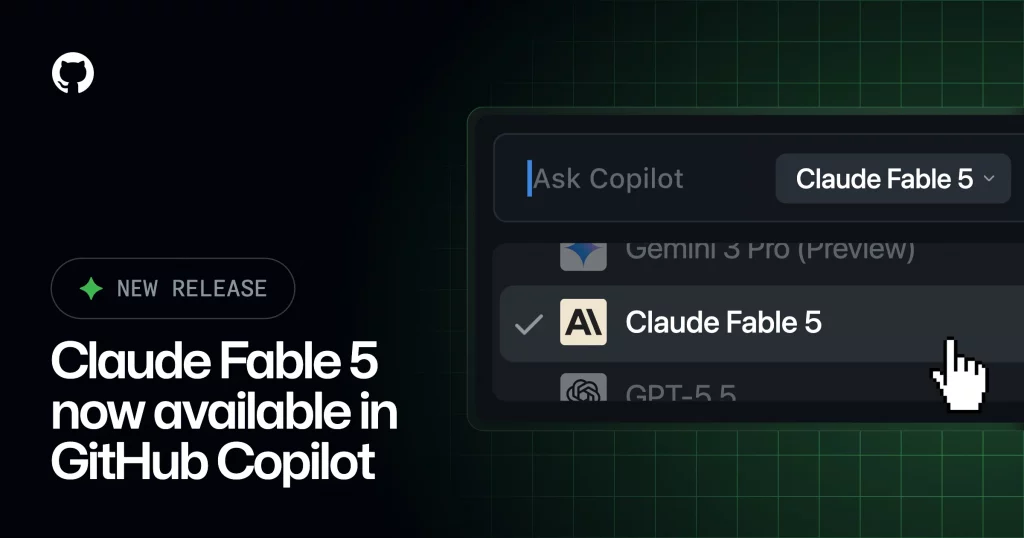
Claude Fable 5 became generally available on June 9, 2026. Developers can access it via:
- Claude API: Use the model string
claude-fable-5. Adaptive thinking is always on; use theeffortparameter to control thinking depth. Full implementation details are available in Anthropic’s API documentation. - Claude Platform on AWS, Amazon Bedrock, Google Cloud Vertex AI, Microsoft Foundry: All major cloud platforms have Fable 5 available from launch.
- Claude.ai consumer and Pro plans: Available at no extra cost from June 9 through June 22, 2026. From June 23, usage on subscription plans requires usage credits; Anthropic intends to restore Fable 5 as a standard plan feature once capacity allows.
One important compliance note: Fable 5 and Mythos 5 are designated Covered Models, which carry a mandatory 30-day data retention requirement. Zero data retention is not available for these models. For enterprises in regulated industries that require data sovereignty controls beyond what the API provides, AI Hive’s on-premise deployment model enables Fable 5 to run within your own infrastructure perimeter
Our Take: Fable 5 Is Real Progress – With One Catch Worth Knowing
The benchmark numbers are hard to argue with. Fable 5 posts an 11-point lead on SWE-Bench Pro over the next competitor, and early testers are not just confirming the scores – they are describing the qualitative shift that numbers rarely capture. Developer Simon Willison, who tests every major frontier release, called this one ‘a major-version-bump-deserving step change forward’ specifically for long, hard problem-solving sessions. That kind of reaction from someone who applies the same probe to every model matters more than a leaderboard position.
From where we sit working on enterprise AI deployments, the most telling signal is not the Stripe codebase migration or the Pokémon benchmark. It is the memory result: Fable 5 improved three times more from persistent file-based memory than Opus 4.8 did under the same conditions. That gap suggests Fable 5 is not just faster at tasks – it uses context differently. For multi-day agentic workflows, that distinction is everything.
That said, there is one aspect of this launch you should know about going in:
- The distillation safeguard is invisible by design. Unlike the cybersecurity and biology classifiers – which notify you when they fire – Fable 5 contains a fourth mechanism that silently degrades response quality for requests flagged as attempts to extract Claude’s capabilities for training competing models. Anthropic disclosed this in the model’s system card – a 319-page document covering safety evaluations, classifier scope, and risk mitigation methodology. They estimate it affects roughly 0.03% of traffic, targeting bad actors who were running industrial-scale data extraction campaigns from Chinese AI labs.
- The technical community reaction was sharper than Anthropic expected. AI researcher Nathan Lambert argued that ‘an AI model that gets less intelligent automatically without notifying me is categorically misaligned AI,’ regardless of who the intended target is. Andrej Karpathy praised the capability leap but flagged the launch-day classifiers as ‘configured to be a little too trigger happy.’
- For most enterprise users, this does not affect you. If your team is building production applications, automating workflows, or running analytical pipelines, none of these mechanisms will touch your sessions. The concern is specific to AI researchers building and training their own models – and even then, primarily to those acting in bad faith.
The honest take: Fable 5 delivers on the capability promise. The safety architecture is genuinely more sophisticated than anything Anthropic has shipped before. The invisible degradation mechanism is a real transparency issue that deserves the criticism it is getting – but it should not change how most enterprise teams evaluate this model for production use.
Conclusion
Claude Fable 5 is a genuine step change in what enterprises can access from a publicly available AI model. It brings Mythos-class reasoning and autonomous capabilities to any team with an API key – at roughly half the price of its predecessor – while maintaining the safety architecture that makes enterprise deployment viable.
For AI Hive’s enterprise clients, Fable 5 represents a new capability tier for agent workflows: one where multi-day autonomous tasks, complex codebase migrations, and long-context analytical work are no longer experiments but repeatable operations. Our enterprise AI platform‘s model-agnostic routing means your AI Agents can leverage Fable 5’s strengths precisely where they are needed, without committing to a single-vendor dependency.
Ready to deploy Claude Fable 5 in a governed, compliant enterprise environment? Contact our team at AI Hive to explore how our Agent Studio and AI Engineers for Hire can help your organization move from testing to production in weeks, not months.